YB Jewish? – Rabbi Jack’s Quarterly Message

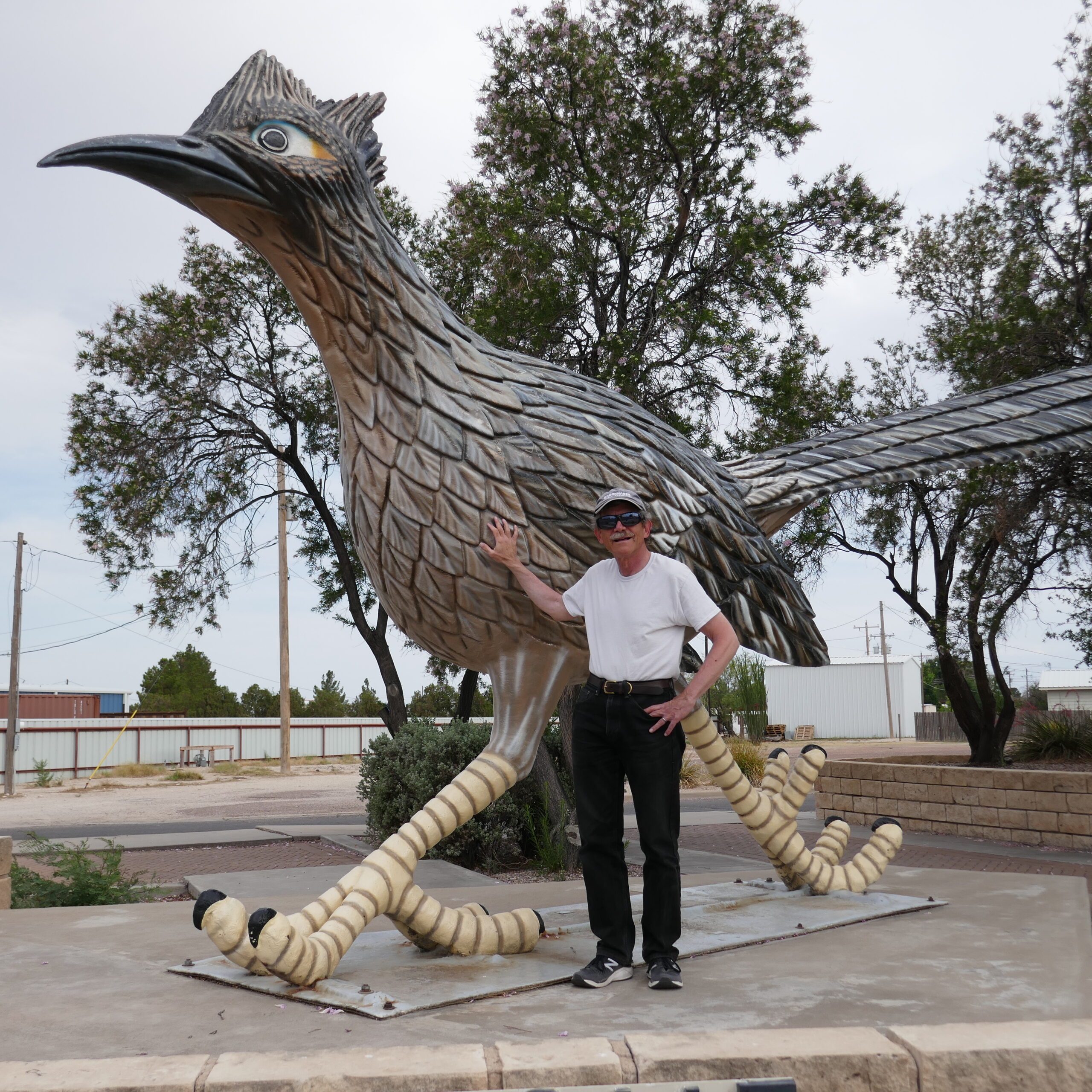
New Mexico’s state bird, the Roadrunner, in Fort Stockton, Texas

Dear Friends:
“I’m not religious – I hardly ever go to synagogue.”  “I not really Jewish – I’m more of an atheist.”  I’ve heard people make those statements, but too often, we conflate being religious with regular attendance at shul or being Jewish with accepting a Biblical or prayerbook definition of God. 

I’m contractually obligated to plug Shabbat services and monotheism, and I do believe there is great value in having people worship communally. I also feel that it is beneficial to avoid self-aggrandizement by recognizing that something greater than ourselves exists. 

But an hour or so a week is not, and should not be, the focus of Judaism, and Judaism is far more prescriptive about how we behave than in what we believe. For those who are Jewish, we are Jewish every hour of every day; it’s up to us to decide how often we daven (pray) or what is our personal theology.
 
Judaism can inform every aspect of our lives: from the moment we awaken to the moment we go to sleep – from what we eat to what we wear – from our birth to our death.  I deliberately used the word “inform” because we have the free will (I think) to follow the advice of our sages or not. But this can only work if we know what those sages say.
 
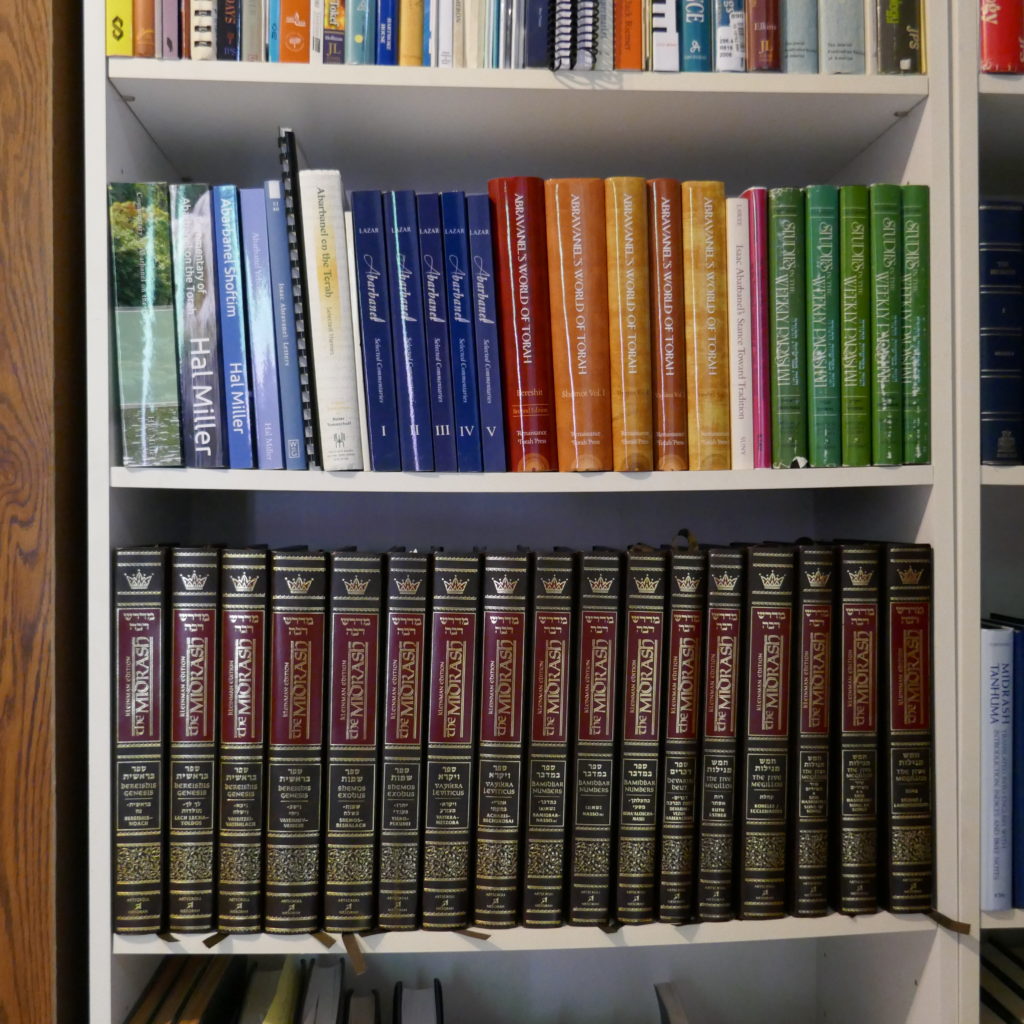
Beverly and I live in a house filled with books*, many of which contain Jewish teachings over the millennia. Certainly, conditions and practices have changed from the time of the Temple in Jerusalem to today.  More than anything, I view Jews as an extended family.  We may have wildly different beliefs, and we may observe rituals in diverse fashions. Nonetheless, we share common ancestors whose understanding of the world and our role in it is part of our heritage.
 
Many of my rabbi activities over the past 3 months were targeted at helping build Jewish community and raising Jewish knowledge. They did not center on synagogue service attendance or a Talmudic understanding of the Divine: I delivered a presentation about Jewish musicians and artists for the New Mexico Jewish Historical Society and a talk about the Jewish community of Guatemala City for a Santa Fe travel store. I participated as part of a rabbinic tribunal in multiple conversions; taught several sessions of the weekly, ongoing, “Exploring the Jewish Experience” program; spoke at an immigration vigil held by our Congresswoman and her office; gave the opening prayer at a session of the New Mexico State Senate; and lectured on free will in Judaism and the theme of hope in Jewish texts at two consecutive interfaith evening events. In partnership with the United Church across the street from the Los Alamos Jewish Center, I championed a joint postcard writing campaign created by Mazon: A Jewish Response to Hunger to urge our government to restore subsidies for those facing food insecurity (https://mazon.org/news/blog/47000-postcards-to-fight-hunger/).
 
In all my rabbinic work, I welcome Jews who have limited or no liturgical background as well as those who are fluent in the Jewish liturgy, and I never ask people to describe the God they believe in (or don’t believe in).  We need all Jews to learn more about Judaism – now more than ever.  So, if you’re not currently actively engaged in any Jewish activity, pick your favorite entry point and embrace some aspect of Judaism. And if it happens to be worship services, I won’t complain when I see you in the synagogue!
 
B’shalom,
Rabbi Jack
 
*In preparation for Passover, Beverly arranged to have our carpets cleaned. The gentleman who performed the task said that he’d seen lots of houses in Los Alamos that have large personal libraries, but he’d never seen as extensive a collection as we have. Perhaps those folks with larger libraries don’t clean their carpets.
 

Rabbi Jack Shlachter
Judaism for Your Nuclear Family
physicsrabbi@gmail.com
www.physicsrabbi.com

Quarterly reading list

How God Works – David DeSteno (audiobook)

The Great Partnership – Rabbi Jonathan Sacks

All My Young Years: Yiddish Poetry from Weimar Germany – A.N. Stencl; tr. Haike Beruriah Wiegand and Stephen Watts 

On Being Jewish Now – ed. Zibby Owens
 
Confrontation and Other Essays – Joseph Soloveitchik

Alay-Oop – William Gropper

Spinoza: Freedom’s Messiah – Ian Buruma (Yale Jewish Lives series)

A Provincial Newspaper and Other Stories – Miriam Karpilove; tr. Jessica Kirzane
 
Who’s Afraid of the Big Bad Jew? – Raphael Shore

Morris Rosenfeld: Selections from His Poetry and Prose – ed. Itche Goldberg and Max Rosenfeld

We Have Reason to Believe* – Louis Jacobs

Here in Santa Fe – Stuart Cohen

Maimonides and Halevi – Harry Austryn Wolfson

Urban Myths of Los Alamos – Mark David Albertson

Nize Baby – Milt Gross

The Los Alamos Primer – Robert Serber

Koren Ethiopian Haggada: The Journey to Freedom – Menachem Waldman

Hand in Hand – Rashel Veprinski; tr. Ellen Cassedy and Anita Norich

I Wanted To Be Wonderful – Lihi Lapid; tr. Amit Pardes (duplicative of Woman of Valor)

Franz Boas: In Praise of Open Minds – Noga Arikha (Yale Jewish Lives series)

Papa: An Elegy – Lali Tsipi Michaeli; tr. Maayan Eitan

Spiral of the Three Mothers – Gershon Winkler and Miriam Maron
Posted in Rabbi Jack's Quarterly

“A book, a book! My kingdom for a book!”

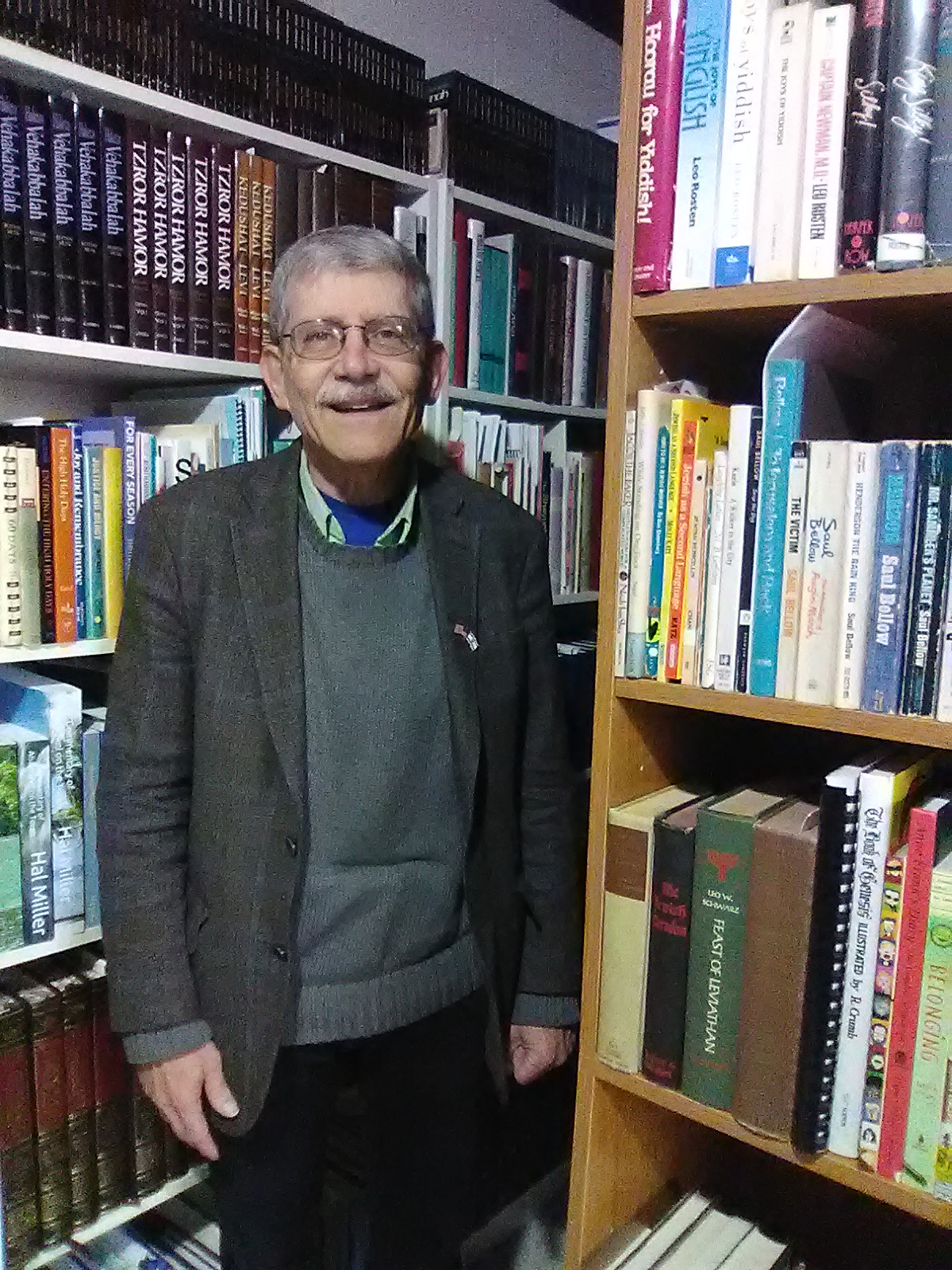
I’m happiest when I’m surrounded by books!

Dear Friends:
I like reading even more than I like eating chocolate! Well, maybe that’s an exaggeration.  But if you’ve read one of my quarterly messages before, you probably won’t be surprised by my assertion that it would be a good thing to reduce the number of distractions we face, allowing us to read more. In the early eighteenth century, a Jewish mystic from Prague named Moses Hasid wrote that “I prefer to pray the less so as to read the more.” [Hebrew Ethical Wills – Israel Abrahams, p. 290]. Rabbis probably can’t fully endorse this tradeoff, and I might lose my ordination if I tell people to pray less, but I think reading really is a wonderful pastime.
 
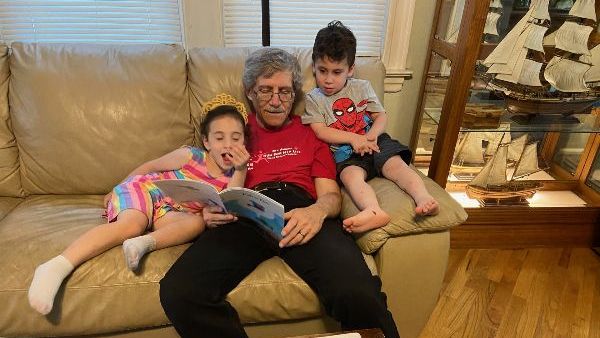
Perhaps more enjoyable than almost any other activity I undertook as a parent was that of regularly reading aloud to my children. This despite the fact that I would sometimes fall asleep while doing so. In order to keep myself alert, I occasionally read from two children’s books at the same time, interweaving the stories on the fly as best I could. The challenge kept me awake even when the subject matter of the books was less than scintillating.  During one of my visits this quarter to New York City for my Sinai and Synapses Fellowship program which explores the intersection between science and religion, I got to read to my great niece and nephew (but they weren’t quite ready for the two-book technique). As an aside, I’m now reading aloud for the Jewish Braille Institute (see below in the reading list).
 
When not reading, I officiated at a number of life cycle events.  Some were truly joyous: the Bat Mitzvah ceremony for one of our young adults in Los Alamos; weddings on consecutive Wednesday afternoons at the very end of December with a great turnout from the Los Alamos Jewish Center to help make a minyan for couples who had few relatives or friends in attendance; and participation in the ritual tribunal (Beit Din) for the conversion of four individuals who joined the Jewish people, now at a time when we need them most. 
 
Some of the life cycle events were sad, however: I officiated at the funeral of the scientist who first hired me into the Laboratory in Los Alamos nearly half a century ago, and I led shiva minyans for Beverly who lost her father in December. Ben Post gifted me a tallit when Beverly and I married, and I continue to feel comforted as I wrap myself in the prayer shawl and remember his many kindnesses to me. Ironically, I had recently ordered another dozen bags of earth from Israel which I use at funerals, and they arrived the very day Ben passed away in Israel. May his memory be a blessing.
 
I delivered a handful of presentations this quarter, speaking about Jewish Humor as part of HaMakom’s Continuing Education series, and about Free Will in Jewish Philosophy and Modern Neuroscience at both the Albuquerque JCC and the University of New Mexico Hillel. I also led services for my two local synagogues as well as for the Hillel, and at Mt. Sinai synagogue in Cheyenne, Wyoming, where I spent a weekend as scholar-in-residence.
 
More outward facing experiences included co-leading the joint Los Alamos Jewish Center – United Church annual Thanksgiving celebration with our neighbors across the street and officiating at two outdoor Hanukkiah-lighting ceremonies at Ashley Pond in Los Alamos.
 
In all of my work, I rely heavily on my personal library which was featured recently in a documentary produced by my dear friends, Ron Duncan Hart and Gloria Abella Ballen.  The library prevents me from aligning myself with Oscar Levant, the great musician and wit, who said, “I’ve given up reading books; I find it takes my mind off myself.”
 
B’shalom,
Rabbi Jack

Rabbi Jack Shlachter
Judaism for Your Nuclear Family
physicsrabbi@gmail.com
www.physicsrabbi.com

Quarterly reading list

How on Earth do we Speak? – (pre-publication) – Mary E. Carter

Woman of Valor – Lihi Lapid; tr. Amit Pardes

Enter These Gates – Alden Solovy

What’s With Baum? – Woody Allen

100 Objects from the Collections of the YIVO Institute for Jewish Research*

Ludwig Wittgenstein – Anthony Gottlieb

The Bubbe Meise* – Aaron Zevy

The Way Into Torah – Norman Cohen

Shlomo Yehudah Rapoport (Shir) and his Contemporaries – Isaac Barzilay 

Leah Goldberg: Selected Poems; tr. Robert Friend

The Narrow Path: Yiddish Short Stories – var. authors; tr. Michael Eric Kovnat

You Don’t Have To Be Wrong For Me To Be Right* – Brad Hirschfield

Free Will – ed. Uri Maoz and Walter Sinnott- Armstrong 

1111 Days in My Life Plus Four – Ephraim F. Sten; tr. Moshe Dor

Carole King: She Made the Earth Move – Jane Eisner

Our Immoral Soul – Nilton Bonder

The Serviceberry – Robin Wall Kimmerer

Wine on Ice – Mordechai Geldman; tr. Haim Pessah

Raysn – Moyshe Kulbak; tr. Jason Wagner

The Rebbe, the Messiah and the Scandal of Orthodox Indifference – David Berger

Your Comrade, Avreml Broide – Ben Gold; tr. Annie Sommer Kaufman

Vangelis Kyris: Light & Thread: A voyage through the collection of Jewish and local costumes at MUZA

The 13 Clocks – James Thurber

The Great Goldbergs – Daniel Goodwin (read aloud for the Jewish Braille Institute)

To Infinity and Beyond – Eli Maor

Shivitti: A Vision – Ka-Tzetnik 135633; tr. Eliyah Nike De-Nur and Lisa Herman

Vera, or Faith* – Gary Shteyngart

Posted in Rabbi Jack's Quarterly

What comes out of our mouths (and noses) – Rabbi Jack’s Quarterly

Adat Israel, Guatemala City

Dear Friends:
One of the luxuries of not making my living as a rabbi is that I don’t deliver very many sermons.  (I suspect this is viewed as a great benefit by my congregants as well).  In fact, I love to follow the tradition that rabbis only offer two sermons a year. 

Historically, those sermons were given on the Sabbath preceding Passover – in order to remind attendees of the intricacies of food restrictions on that holiday – and on the Sabbath between Rosh HaShanah and Yom Kippur – to inspire us to continue our process of repentance as we approach the Day of Awe.  For many years now, I have modified that custom and speak only on the eve of the New Year and the eve of the Day of Atonement.
 
This past Yom Kippur I delivered my second (and final!!) sermon of the year while leading congregation Adat Israel in Guatemala.  For my remarks, I spoke about how important it is that we are careful with our speech, and I pointed out that a significant fraction of the items listed in the public confessional prayers on Yom Kippur relate to things we say, particularly about other people.  So, without a doubt, we should be careful about what comes out of our mouths.
 
In this (post?) Covid world, many of us have become especially conscious about what comes out of our noses as well, and how we can hurt those around us by failing to catch our sneezes.  If you’re like me, you may instinctively say “God bless you” when someone sneezes, but we often forget what we even mean by a blessing.
 
There is a wonderful Jewish tradition that we are to recite 100 blessings a day (B. Men. 43b and see the comprehensive article at https://outorah.org/p/36791/).  Elsewhere in the Talmud (B. Ber. 60b) we are provided with text for a series of blessings to be recited upon awakening. 

The practice of starting the day off by recognizing things for which we should be grateful not only made sense thousands of years ago but seems extremely relevant even today.  There is no guarantee that we will wake up to a new day, and the rabbis likened sleep to death.  Hence, when we realize that we are again conscious, we should express our thanks.  Similarly, when we open our eyes, we are encouraged to acknowledge our gift of sight.  The Talmud continues to say that when we dress ourselves, we should recite a blessing to God who clothes the naked (apparently, pajamas were invented after the Talmud was codified).
 
Subsequently, those passages were transferred to the synagogue where they became a sequence of fifteen morning blessings.  There are two blessings in the collection of codified synagogue morning blessings for which I recently gained additional appreciation. 

The first is the blessing that was associated with sitting up straight from one’s bed – one is to say, “Blessed are You who sets captives free (matir assurim).”  Those words were extremely powerful and present as the Los Alamos Jewish Center, along with thousands and thousands of other Jewish communities around the world, came together publicly with great joy yet mixed with sadness when the last of the living hostages were released by Hamas.  May we never again face such a situation, and may our recitation of that blessing remind us how fortunate we are to be free.
 
The second blessing that jumped out at me recently is more liturgically controversial.  Some prayerbooks say “Blessed are You who has not made me a heathen,” or in the positive variant, we find “Blessed are You who has made me an Israelite (or Jew).”  The text in the Talmud probably underwent censorship as evidenced by a difference between printed versions and manuscripts (see, eg., My People’s Prayer Book Volume 5 p.26 note 1). 

It is not my intention to explore here the pros and cons of the positive/negative formulations but rather to express my thanks to Adat Israel for enhancing my awareness of the blessing of being Jewish.  No other congregation has ever shared with me such enthusiasm when reciting these words.  Bendito sea el Dios Eterno, quien me ha hecho judio (as the book we used in Guatemala stated!).  And let us say, Amen.

B’shalom,
Rabbi Jack

Rabbi Jack Shlachter
Judaism for Your Nuclear Family
physicsrabbi@gmail.com
www.physicsrabbi.com

My reading list for the past quarter follows here with an asterisk denoting a work of particular interest to me.

What Makes an Apple? – Amos Oz with Shira Hadad; tr. Jessica Cohen

The Liar – Ayelet Gundar-Goshen; tr. Sondra Silverston

Class Clown: The Memoirs of a Professional Wiseass – Dave Barry

The Way Into Jewish Prayer – Lawrence Hoffman

Sex Ethics in the Writings of Moses Maimonides – Fred Rosner

Whitewash: Poland and the Jews – Jan Grabowski

The Old Story – Mendele Moykher Sforim; tr. Jane Peppler

The World of the High Holy Days Volume 3* – edited by Rabbi Jack Riemer 

The Shoes of Tanboury – Shimon Ballas

Mishkan Halev: Prayers for S’lichot and the Month of Elul – ed. Rabbis Janet and Sheldon Marder

Origins of Life – Freeman Dyson

The Einstein Effect – Benyamim Cohen

A Cure for Sorrow – R. Shem Tov Ibn Falaquera; tr. Yitzhak Berdugo

Manasseh of Ilya: Precurser of Modernity Among the Jews of Eastern Europe – Yitzhak Barzilay

The Black Hole of Auschwitz – Primo Levi; ed. Marco Belpoliti; tr. Sharon Wood

A Letter in the Scroll – Jonathan Sacks

Drops of Joy – Moshe Shklar; tr. various 

Yiddish Short Stories – ed. Isaac Goldbert; tr. various

The Sacred Count of Days – Vincent James Stanzione

Elephants by Night – Abraham Sutskever; tr. Mel Konner

Ada – Vladimir Nabokov

Posted in Rabbi Jack's Quarterly

Seder – You With the Stars in Your Eyes

Los Alamos Community Seder at “Pig and Fig” Restaurant in White Rock, New Mexico. Photo courtesy Carol A Clark/ladailypost.com

Dear Friends:
As I write this quarterly message, I’m recuperating from leading successive community Seders in Santa Fe for HaMakom and Los Alamos for the Los Alamos Jewish Center.  It strikes me that the Exodus story I’d have loved to have told would have had Moses commanding the people that as soon as they finished preparing the red chile breakfast burritos, everyone had to move out of Egypt posthaste and head to the wilderness.  (Can you tell that I don’t like eating matzah?)
 
Nonetheless, I love the holiday of Passover.  It brings back memories of Seders from when I was a child, and I’m reminded that I was referred to in our family as the wise son.  No, that’s not quite right – I was the wise guy!  I can even remember having a non-Jewish friend dress up as Elijah and stand at the door to surprise whoever opened it before we sang Eliyahu HaNavi.
 
On the second day of Pesach, I Zoomed in to East Midwood Jewish Center in Brooklyn where Beverly used to worship and which I’ve attended on occasion.  (Surely Zoom services are a thin silver lining in the otherwise dark cloud of the COVID pandemic).  EMJC’s Rabbi/Cantor Sam Levine not only has a beautiful voice but is a wise and inspirational leader.  He spoke about Elijah and his multiple roles in Jewish texts, viz., announcing the coming of the Messiah or Messianic Era, resolving Talmudic disputes, and reconciling children to parents and parents to children.
 
The association of Elijah with the Messianic Age derives from II Kings 2:1-11 in which a chariot and horses of fire appears, and Elijah is described as ascending to Heaven in a whirlwind.  Since he did not “die,” Elijah is thought to wander the earth, often disguised as a poor man.  In the Haftarah I chanted on Shabbat HaGadol only hours before the first Seder this year, we heard from the prophet Malachi 3:23 that Elijah would be sent by G_d “before the coming of the great and awesome day of the Lord.”  We sing about Elijah when that door is opened because we yearn for the redemption which he will herald, and we also sing that song at the conclusion of Shabbat because we pray that the announcement will come in the new week which is starting.
 
Elijah’s role in settling arguments about Jewish law is dependent on a backronym, an acronym deliberately formed from a phrase whose initial letters spell out a particular word or words.  In the Talmud, the word teyku concludes an open-ended argument and means, literally, “let it stand,” or “we’re stuck.”  But creatively, one can read teyku as shorthand for Tishbi y’taretz kush’yot U-ve’ayot – “Elijah the Tishbite will resolve all problems and difficulties.”
 
Lastly, the final verse of the Book of Malachi 3:24 states that when Elijah comes, “he shall reconcile parents with children and children with their parents.”  Apparently, parental estrangement was an issue even thousands of years ago, but the contemporary psychologist and author, Dr. Joshua Coleman, argues that our emphasis on individualism in today’s society has driven epidemic levels of adult children cutting off contact with parents.  On a deeply personal level, I pray that Elijah comes soon.  Ken yehi ratzon – so may it be G-d’s will.
 
B’shalom,
Rabbi Jack

Rabbi Jack Shlachter
Judaism for Your Nuclear Family
physicsrabbi@gmail.com

Below is my reading list from the past quarter, with an asterisk denoting a particularly enjoyable selection.  Don’t be deceived – there are several short poetry collections embedded therein.

The Last Kings of Shanghai* – Jonathan Kaufman

Love – Maayan Eitan

Next Generation Judaism – Mike Uram

Marrano Mountain* – Amnon Shamosh; tr. Suzy Shabetai

Hasidic Wisdom: Sayings from the Jewish Sages – Simcha Raz; tr. Dov Perez Elkins and Jonathan Elkins

Determined: A Science of Life Without Free Will – Robert Sapolsky

Meant to Be – Shira Gorshman; tr. Faith Jones

Megaovertone: Selected Poems 1952-1966 – David Avidan; tr. the poet and Abraham Birman

From Island to Island – Harold Schimmel; tr. Peter Cole

Yma, Ava; Yma, Abba; Yma, Oona; Yma, Ida; Yma, Aga…and Others – Thomas Meehan

The Books of Jacob – Olga Tokarczuk; tr. Jennifer Croft

The Bibliomaniacs* – J.C. Halper

Sepher Ha-Razim: The Book of Mysteries – tr. Michael Morgan

Poems by Zalman Shazar – tr. Joseph Leftwich

Beaufort* – Ron Leshem; tr. Evan Fallenberg

Life in a Mirror – Israel Emiot; tr. Francesca Guli’ et.al.

Day – Amir Or; tr. Amir Or and Fiona Sampson

The Last Laugh – S.J. Perelman

Hayim Nahman Bialik: Poet of Hebrew* – Avner Holtzman; tr. Orr Scharf(The epilogue served as our siyyum text for overriding the fast of the firstborn before Passover this year)

Chaim Nachman Bialik: Selected Poems – tr. Ruth Nevo

The Dick – Bruce Jay Friedman

Posted in Rabbi Jack's Quarterly

The Road Less Traveled

Dear Friends:
 
In the opening words of an oft-cited poem by Rabbi Alvin Fine, “Birth is a beginning, and death a destination, and life is a journey.” Using that image, I believe that Judaism can provide us with unique markers along the path.  These markers are designed to enhance our appreciation that our lives are both meaningful and valuable.
 
At early stages, we are welcomed into the community through Brit Milah (circumcision) or naming rituals.  As we mature, we become familiar with our Jewish traditions during weekly events like Shabbat, e.g., through the lighting of candles or the blessings we receive from our parents.
 
On a longer timescale, we start to recognize annual holidays as we participate in Passover seders, help build and eat in (or even sleep in) sukkot, dress in new clothes for the High Holidays, don costumes for Purim, and spin dreidels on Hanukkah.  And we enjoy transitional life ceremonies including those commemorating our becoming Bar or Bat Mitzvah and those that celebrate our choice of a life partner.  Finally, we acknowledge our mortality when we observe Jewish burial practices at the death of a loved one.
 
In my rabbi work over the last quarter, I’ve been fortunate to play a role in many aspects of this trajectory by assisting others on their life journeys. I emphasize to others that Judaism is not all about weekly synagogue attendance (though I’m happy when people come to worship services). Jewish practice is a mechanism for helping integrate individuals into a community.  Judaism can therefore place our lives in a broader, richer context than would otherwise be possible. 

As we chart the journey of our lives, the teachings of a Rabbinic work called Pirke Avot (Chapters of the Sages 5:21) can serve as signposts on our progress.  “At five years of age the study of Scripture; At ten the study of Mishnah; At thirteen subject to the commandments; At fifteen the study of Talmud; At eighteen the bridal canopy; At twenty for pursuit [of livelihood]; At thirty the peak of strength; At forty wisdom; At fifty able to give counsel; At sixty old age; At seventy fullness of years; At eighty the age of “strength”; At ninety a bent body; At one hundred, as good as dead and gone completely out of the world.”  Perhaps some of these signs need to be moved a bit, but I still find the text to be informative.

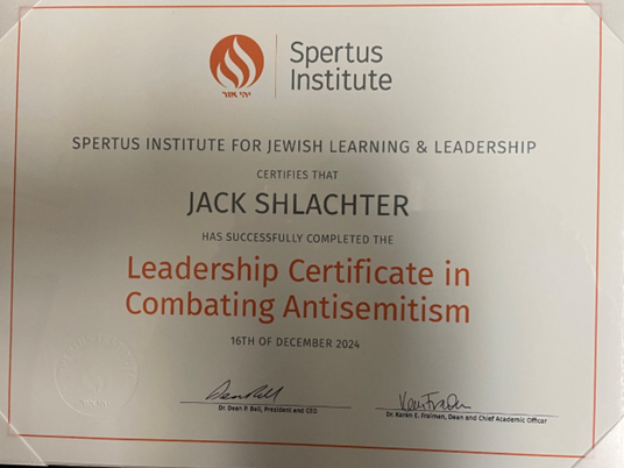
I recently spoke with someone who is considering converting to Judaism, and one of her reasons for caution is the hostility displayed towards Jews that we see today. This woman worried about what she might be subjecting her children to in the future. While I don’t at all downplay antisemitism (see photo of my Leadership Certificate in Combating Antisemitism through the Spertus Institute), I think that being Jewish is a gift that can add immeasurably to our lives.  I welcome your insights into the benefits of living a Jewish life, in whatever way you’ve chosen to lead it.
 
B’shalom,
Rabbi Jack

Reading list for the quarter

Quarterly reading list (asterisk denotes book of especial interest)
 
Constantine’s Sword – James Carroll

One Palestine, Complete – Tom Segev; tr. Haim Watzman

Jews in Thailand – Ruth Gerson and Stephen Mallinger

Ya’akobi & Leidental – Hanoch Levin; tr. Dennis Silk and Shimeon Levy

They Are No More – Z. Segalowicz; tr. Amelia Levy

The Sound of a Thousand Stars – Rachel Robbins

Children of the Shadows – Ben-Zion Tomer; tr. Hillel Halkin

The A.B. Yehoshua Controversy: An Israel-Diaspora Dialogue on Jewishness, Israeliness, and Identity – ed. Noam Marans and Roselyn Bell

The Universal Square: Translations – Uri Tzaig; tr. Sondra Silverston, Richard Flantz, Peter Cole, et.al.

The Pawnbroker – Edward Lewis Wallant

How Judaism Became a Religion – Leora Batnitzky

Stones in the Darkness – Nathan Yonathan; tr. Richard Flantz

The Clever Little Tailor – Solomon Simon; tr. David Forman

Time Travel – James Gleick

Search the Scriptures: Modern Medicine and Biblical Personages – Robert Greenblatt

Confessions of a Murderer* – Joseph Roth; tr. Desmond Vesey

The Amen Effect – Sharon Brous
 
Half-Truths & One-and-a-Half Truths – Karl Kraus; tr. Harry Zohn

A Chosen Calling: Jews in Science in the Twentieth Century – Noah Efron

The King of Lampedusa – S.J. Harendorf; tr. Heather Valencia 

Payback – Elisha Porat;tr. Alan Sacks, et.al.

The Chemical History of a Candle – Michael Faraday (inspired by Hanukkah and with no explicit Jewish content, but makes a beautiful connection between humans and candles at the end)
Posted in Rabbi Jack's Quarterly

From the “New” New World

Shabbat Shuvah in Bangkok, Thailand, 2024

Dear Friends:
Recently I have fallen into a modest exercise routine which involves racking up steps on my pedometer most mornings while listening to classical music; truth be told, as an avid indoorsman, I am usually marching around in my basement.

Once I’ve selected a particular composer, I listen to his (not too many women, unfortunately) symphonies sequentially; often I try to detect a development in style as the composer matured.  Most composers last me about a week, give or take (think Beethoven’s 9 symphonies), and no, I did not go through all 104 Haydn symphonies!

About two weeks ago, I made my way to Antonin Dvorak, the great 19th century Czech composer.  (Seeking Jewish connections, I learned that Dvorak was not Jewish, but he was a major influence on Erwin Schuloff whose compositional career was extinguished when he was deported to the Wülzburg prison where he died in 1942). 

Methodically I began with Dvorak Symphony #1 which he composed at age 24 and which I find delightful and exhilarating.  As the days progressed, however, I found myself dreading day 9 and the famous work, From the New World, commissioned and written by Dvorak during his extended American visit in his mid-50s.  In my mind’s ear leading up to number 9, this symphony was overblown and overplayed, and I was sure I’d be bored.

Surprisingly, however, this piece which I’ve probably heard dozens if not hundreds of times, sounded refreshingly wonderful when the ominous day arrived.  And herein lies a lesson, perhaps.  I’m not the same person I was when I last listened to this composition, and maybe this is how we can approach situations, books, and even people with whom we’ve become disenchanted.

Think, for example, of our annual cycle of reading the Five Books of Moses, one portion a week beginning with Simchat Torah and progressing until the following Simchat Torah when we approach Genesis Chapter 1 yet again.  The text remains the same year after year, but each time we read the appropriate verses, we read them with new insights and ideas because we’ve changed in the intervening time.  Each of our life experiences adds a dimension to our understanding of the world around us. 

Of the Torah, the first century CE sage known as Ben Bag Bag (probably a pseudonym to hide the fact that he’d converted to Judaism against Roman law) says “turn it and turn it again, for all is in it” (Pirke Avot 5:22).  There’s always something new to learn because we’re renewed each day, something for which we should always be grateful.

This past quarter, I had the honor to officiate at a wedding, multiple conversion ceremonies, and a Bat Mitzvah; to deliver a sermon on antisemitism at several local churches; to participate as part of a cohort of Jewish leaders on Combating Antisemitism through the Spertus Institute in Chicago; to deliver two talks about Jewish American Nobel Physics Prize Winners; to serve on a panel of rabbis at the Albuquerque JCC on the topic of the High Holidays; to teach a pair of classes at the Los Alamos Jewish Center on the liturgy of Rosh HaShanah and Yom Kippur; to lead services for the Thailand Progressive Jewish Community in Bangkok; and to lead Shabbat services both at home in Los Alamos, and in Santa Fe at HaMakom.  With each of these activities, there was the potential to act in autopilot mode, yet I am energized whenever I expand my Jewish experiences, and I always learn something in the process.

Ben Bag Bag speaks of “Torah,” he is talking of Torah in its broadest sense – we should turn it and turn it again, for indeed, all is in it.

B’shalom,
Rabbi Jack

Reading list for the quarter

Below is my reading list from the past quarter, with an asterisk denoting a particularly good selection. 

Bruno Schulz: An Artist. A Murder. And the Hijacking of History* – Benjamin Balint

Einstein: A Stage Portrait – Willard Simms

Guide to Yiddish Short Stories – Bennett Muraskin

The Quiet City: A Play in Two Acts – Irwin Shaw

Antisemitism: Here and Now – Deborah Lipstadt

Three Prose Works – Else Lasker-Schuler; tr. James Conway

The Fran Lebowitz Reader* – Fran Lebowitz

Loss of Memory is Only Temporary – Johanna Kaplan

Limassol – Yishai Sarid; tr. Barbara Harshav

Inheritance (Yerushe) – Peretz Markish; tr. Mary Schulman

Alfred Dreyfus: The Man at the Center of the Affair* – Maurice Samuels

Indignation – Philip Roth

Weights and Measures* – Joseph Roth; tr. David Le Vay

An American Type – Henry Roth

Golda Meir: Israel’s Matriarch* – Deborah Lipstadt

World of the High Holy Days Volume II – ed. Jack Riemer 

These Holy Days: A High Holidays Supplement After October 7 – Ed. Ora Horn Prouser and Menachem Creditor 

Pascin – Joann Sfar; tr. Edward Gauvin

End of Days – Haim Hazaz; tr.

The Big Bow Mystery – Israel Zangwill

The Road to Miltown – S.J.Perelman

David Golder* – Irene Nemirovsky; tr. Sandra Smith

Posted in Rabbi Jack's Quarterly

Think before you speak. Read before you think.

Reading to the next generation: our niece’s children.

Dear Friends:
According to the book Hebrew Ethical Wills, selected and edited by Israel Abrahams, there is a beautiful custom dating back millennia for Jews to compose testamentary directions for the religious and secular guidance of their children. 

In Abrahams’ anthology, there is a passage from an ethical will composed by Moses Hasid and published in the early 18th CE. The author says, “I prefer to pray less so as to read more.”  I suspect that not every rabbi would subscribe to this sentiment, but I’d like to devote this quarterly message to the topic of reading, an activity that I value above most others (to the occasional dismay of Beverly, who thinks – for reasons I cannot fathom – that it is unhealthy for me to stay indoors 24 hours a day).
 
I derived tremendous joy out of reading nightly to Dov and Orli when they were young, though admittedly I would occasionally fall asleep in the middle of one of their stories.  It is my contention that reading to one’s children is among the most important actions that parents can take to launch their progeny on a lifelong love of learning.
 
When we read, we are able to journey to different eras and locales, experience different cultures, and gain insight into different perspectives than our own. While the phrase “People of the Book” was first applied by Muslims to those with a previous scriptural revelation, many Jews have now appropriated those words to refer to ourselves. The eminent Harvard scholar, Harry Wolfson, stated that, “As far as I know, we are the only people who, when we drop a book on the floor, we pick it up and kiss it.”  (I’m not sure of the custom associated with a Kindle).
 
Beverly and I made a few trips to New York this past quarter; the first one provided me with an opportunity to sing on the stage of Carnegie Hall, and on the second, we celebrated with a dear friend who turned 83-years of age.  By rabbinic math in which a full life is ascribed to 70 years, he became 13 for the second time. Friends and family of the “Bar Mitzvah” came from all over to share in the joy as he read from the Torah scroll. This individual set a tremendous example to all who attended, showing that reading and learning in Jewish tradition never cease.  While in New York on that trip, several former congregants came up to me to say that they enjoy reading my quarterlies.  I was filled with gratitude.
 
On our New York subway rides, I was acutely conscious that by wearing a kippah, I was telegraphing my Jewish background, and I remain deeply troubled by the alarming rise in antisemitism in this country and throughout the world.  I’ve been continuing making the rounds of local churches and sermonizing on antisemitism; my goal is to build as large a community of allies as possible to help combat this scourge.  You’ll see below in the list of books I’ve read recently a few more works that help inform my understanding of antisemitism, and I’m honored to have been accepted as a member of the newest cohort for an intensive through the Spertus Institute in Chicago entitled Leadership Certificate Program in Combating Antisemitism for Professionals. I don’t doubt that we’ll get a huge reading list!
 
Am Yisrael Chai and B’shalom,
Rabbi Jack
 
*the quotation “Think before you speak. Read before you think.” is attributed to Fran Lebowitz

Reading list for the quarter

An asterisk* denotes a book I particularly enjoyed reading.
 
Jews Don’t Count – David Baddiel

J’Accuse* – Aharon Shabtai; tr. Peter Cole

Childe Harold of Dysna – Moyshe Kulbak; tr. Robert Adler Peckerar

In the Land of Happy Tears – ed. David Stromberg; tr. various

The Drive – Yair Assulin; tr. Jessica Cohen

Bauhaus Tel Aviv: An Architectural Guide – Nahoum Cohen

The Only Daughter* – A.B. Yehoshua; tr. Stuart Schoffman

The Kaddish Prayer: a New Translation with a Commentary Anthologized from Talmudic, Midrashic, and Rabbinic Sources – Nosson Scherman

The Humbling – Philip Roth

What is Life? – Erwin Schrodinger

Amos Oz: Writer, Activist, Icon* – Robert Alter

The Way to the Cats – Yehoshua Kenaz; tr. Dalya Bilu

Blessed Hands – Frume Halpern; tr. Yermiyahu Ahron Taub

The Problem of Space in Jewish Mediaeval Philosophy – Israel Isaac Efros

Thistles: Selected Poems of Esther Raab; tr. Harold Schimmel
 
Medical Frontiers and Jewish Law: Essays and Responsa; ed. Walter Jacob

The Crime of Writing – Haim Lapid; tr. Yael Lotan

The Hebrew Teacher – Maya Arad; tr. Jessica Cohen

Medicine and Jewish Law: Volume II – ed. Fred Rosner

One Hundred Saturdays*: Stella Levi and the Search for a Lost World – Michael Frank

Feynman’s Tips on Physics* – Richard Feynman, Michael Gottlieb, and Ralph Leighton

The Forgotten Physicist: Robert F. Bacher, 1905-2004 – Alan Carr

Desires – Celia Dropkin; tr. Anita Norich

Posted in Rabbi Jack's Quarterly

That’s All Folks!

My father, Bernard Shlachter of blessed memory, was born 100 years ago this month.

Dear Friends:

When I was a kid, I enjoyed watching cartoons. The sign off for Looney Tunes (That’s All, Folks) meant time to go back to something more productive than television, and I was never terribly happy about that. Endings often have an element of sadness associated with them.  In Jewish history, the destruction of the Temple, particularly the Second Temple, was a hugely traumatic event and ended the whole construct of sacrificial worship. 

Weekly, we mark the end of Shabbat with a Havdalah ceremony that includes smelling spices.  One explanation for this custom is to cheer us up as the Sabbath departs.  And, of course, we mark the end of someone’s life with a funeral service, an event that’s clearly steeped in sadness. 

Yet often in Jewish tradition, an ending serves as a passageway to the next phase.  The Temple is gone, but prayer substitutes for sacrifice.  Shabbat ends, but the new week begins.  A life ends, but memories and lessons from someone’s life remain with us.  Simchat Torah, the day which ends the fall holiday season, is observed by reading the final passages from the last book of the Torah, and then we start all over again moments later. Perhaps we should look at endings as transitions and acknowledge the liminality as opportunities for growth.
 
This past quarter, I conducted several communal Havdalah ceremonies.  Beverly and I shared the conclusion of Shabbat with Temple Montefiore in Las Vegas, NM, over Martin Luther King Day weekend, and I offered some teachings from the great rabbinic advocate for civil rights, Abraham Joshua Heschel. 

The Los Alamos Jewish Center has been holding a once-a-month community third meal/program/Havdalah for a while now, and one of the programs was modeled on the popular public radio program called Selected Shorts which included readings of short stories by several Jewish writers.  The Albuquerque-based Chavurat HaMidbar provided me with an opportunity to reprise my talk about Lewis Strauss and J. Robert Oppenheimer, and we ended the evening with Havdalah. 

And Beverly and I traveled 700 miles to attend Hora Eclipse 2, an Israeli Dance weekend that was held at a Jewish camp which lay along the path of totality just outside Waco, Texas.  Beverly was rewarded with three solid days of Israeli dance (unfortunately I was unable to participate because of a severe attack of danceaphobia, but I got a lot of reading accomplished), and I led an outdoor Havdalah ceremony where I extinguished the candle flame and said that we hoped the sun would be extinguished the subsequent Monday.  Indeed, clouds obscured much of our four minutes of totality, but we did get to enjoy the incredible experience of a total solar eclipse during the last 20 seconds or so of totality.  Sometimes endings can be wonderful!
 
I also spoke this quarter at the memorial service for Bert Heil, longtime member of the Los Alamos Jewish community, and I conducted the funeral for Dr. Robert Sacks, distinguished tutor from St. John’s College.  May their memories be a blessing.  In conjunction with my attendance at the second annual Stand With Us Rabbis United conference in Los Angeles, I was able to visit the grave of my parents on my mother’s Yahrzeit.  My mom’s physical end was 8 years ago, but she lives on in my memory and the others who loved her.
 
B’shalom,
Rabbi Jack


Rabbi Jack Shlachter
Judaism for Your Nuclear Family
physicsrabbi@gmail.com
www.physicsrabbi.com

Reading list for the quarter

Not all of the following were read at the Hora Eclipse 2 dance camp, but I did make it through Nirenberg’s book from start to finish while there!  An asterisk denotes a book of special value to me.
 
Cheerful Moments: Short Humorous Stories – B. Kovner (Jacob Adler); tr. Abraham London

Sayings of Yakov Frank – tr. Harris Lenowitz

Seize the Day – Saul Bellow 

18: Jewish Stories Translated From 18 Languages – ed. Nora Gold

Hebron Stories* – Yitzhaq Shami; tr. from Hebrew by several translators

Conscious Community – Rabbi Kalonymus Kalman Shapira; tr. Andrea Cohen-Kiener

Swamp Story – Dave Barry (no Jewish content, but I like Dave Barry)

Judith – Miriam Karpilove; tr. Jessica Kirzane

Saints and Sinners in Milltown – Ron Duncan Hart

An Anthology of Practical & Clever Phrases – Abraham Schneider; tr. Daniel Kennedy

How the Other Half Lives – Jacob Riis

Stupid Ways, Smart Ways to Think About God – Michael Shevack and Jack Bemporad

Sloan-Kettering – Abba Kovner; tr. Eddie Levenston

The Treasure – David Pinski; tr. Ludwig Lewisohn
 
Tales of the Prague Ghetto – Siegfried Kapper; tr. Jordan Finkin

Moods – Jacob Rodack; tr. Daniel Kennedy

How to Fight Anti-Semitism – Bari Weiss

The Deadly Rise of Anti-Science – Peter Hotez

Seder Interrupted: A Post-October 7 Haggadah Supplement – ed. Ora Horn Prouser and Menachem Creditor

The Hebrew Alphabet – Edward Hoffman

Israel, Palestine and Peace* – Amos Oz

Israel: A Simple Guide to the Most Misunderstood Country on Earth* – Noa Tishby

Anti-Judaism – David Nirenberg

Previous talks and articles

Antisemitism talk at Unitarian Universalist, Jan 2024:
Click here

Are Physics and Religion in Harmony or Conflict? Podcast with Daniel Whiteson:
Click here

Cal Tech Archives interview:

https://heritageproject.caltech.edu/interviews-updates/rabbi-jack-shlachter

Santa Fe New Mexican article about Exploring the Jewish Experience program:
https://www.santafenewmexican.com/news/local_news/beyond-hebrew-school-new-course-delves-into-jewish-religion-culture-and-history-for-adults/article_ec339f6c-bb00-11ee-aa23-5bf9033b8844.html

Jack interviewed on Israeli TV (in English) about Oppenheimer film: https://www.youtube.com/watch?v=8DLXLs7Z0lU

At the Heart of the Film Oppenheimer is a Clash Between Real Life Jews (Jewish Telegraphic Agency article)https://www.jta.org/2023/07/16/ideas/at-the-heart-of-the-film-oppenheimer-is-a-clash-between-real-life-jews

Oppenheimer Helps Raise Awareness of Los Alamos Jewish Community (Santa Fe New Mexican): https://www.santafenewmexican.com/news/local_news/oppenheimer-helps-raise-awareness-of-los-alamos-jewish-community/article_5b0447cc-50e7-11ee-849e-9762395279c3.html


Two Rabbis Discuss Oppenheimer and Jewish Ethics (with Rabbi Raphael Zarum): https://www.youtube.com/watch?v=3ZHmqQUO4UE&list=PLmg8fwxbUbH3mAuwSr9-l2fByIsS1-Xf2&index=9

Fifty (Well, Maybe Two) Shades of Grey: Nuance in the Relationship Between Lewis Strauss and J. Robert Oppenheimer (sponsored by the J Robert Oppenheimer Memorial Committee, recorded at SALA event center in Los Alamos): https://www.youtube.com/watch?v=wb7oMfKZjQg&t=3682s

Finally! Part 2 of Jewish Perspectives on Termination of Pregnancy: https://www.youtube.com/watch?v=jwqvIpW5svs

Jews in the Manhattan Project for the Santa Fe Distinguished Lecture Series – https://www.youtube.com/watch?v=ehxFELPrRhg&t=28s)

The Forward article on Oppenheimer and Strauss: https://forward.com/culture/554486/robert-oppenheimer-movie-nolan-lewis-strauss-jewish/

Rabbi Jack quoted in this article about the Jewish Catalogs: https://forward.com/culture/553586/diy-ritual-jewish-catalog-havurah-hippie-strassfeld/

Click here for a recording of part 1 of a 2-part class entitled “Jewish Perspectives on Termination of Pregnancy,” presented at the Los Alamos Jewish Center.

Posted in Rabbi Jack's Quarterly

Physics meets Judaism (again)

Rabbi Jack with Lindsey and Zachary under the chuppah

Dear Friends:
This being another in a series of quarterly missives from a physics rabbi, I’d like to share with you a few thoughts about relationships, mostly from a Jewish perspective (don’t panic – there will be no equations!). 

In physics experiments, it is often the interaction between particles that evokes the most interest.  My research was focused on nuclear fusion, a process that brings lightweight nuclei together to produce something new.  Isotopes of hydrogen, for example, can fuse and form helium, and in the process, energy is released. This is how the sun and all stars work. 

Similarly, in human beings, it is the interactions between people that are particularly interesting, and it struck me recently that Jewish life cycle events largely mark a fundamental shift in relationship.
 
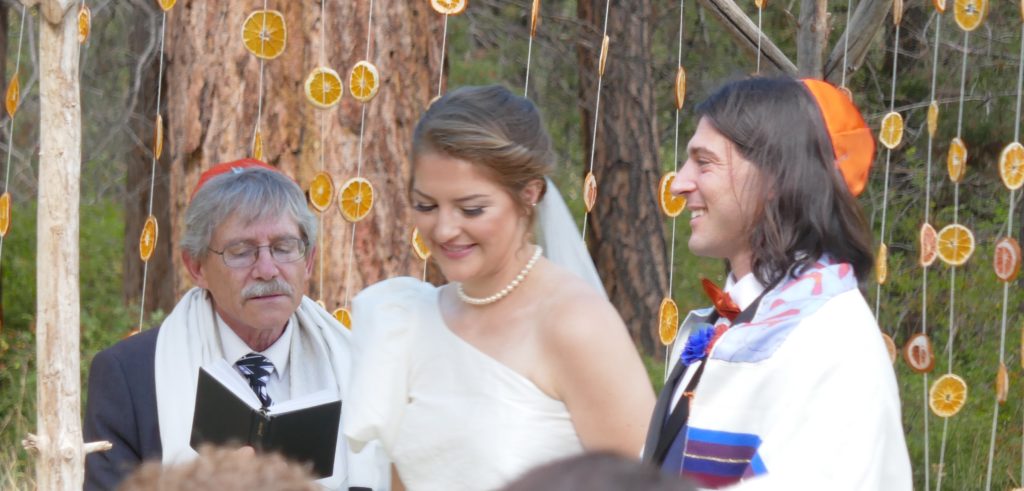
Weddings are perhaps the most obvious example of this principle: under the chuppah, two adults come together to form a completely new entity – a married couple.  I love conducting wedding ceremonies and being present as this shift in relationship occurs. 

A Bar or Bat Mitzvah ceremony also signifies a shift in relationship.  In this case, it marks a moment when a young person becomes identified as a card-carrying member of the worldwide adult Jewish community. I always stress that Jews become Bar or Bat Mitzvah – they don’t have a Bar or Bat Mitzvah.  Many Jewish teens participate in a Bar or Bat Mitzvah ceremony, but the shift in status occurs when the young person comes of age, regardless if the occasion is marked with a religious service or a party.  Nonetheless, Jews who never celebrated the occasion often feel less than, which I think is terribly unfortunate. 

It is always an option to celebrate being a Bar or Bat Mitzvah in conjunction with a worship experience, and I am looking forward to participating as a dear friend marks his 83rd birthday with a ceremony.  Why 83, you ask?  A rabbinic teaching suggests that 70 years of age marks a full life, and by sophisticated mathematics, 83 years of age is a second chance at publicly and joyously reaffirming one’s connection to the adult Jewish community.  I note, as an aside, that my full life moment is rapidly approaching!
 
Birth is a miraculous event that establishes the relationship between a new human being and the human race, and by extension, Brit milah/baby naming events publicize the establishment of a new relationship between an infant and the Jewish people. 

Death, on the other hand, marks the severing of the physical relationship between an individual and those who remain alive.  One responsibility of the survivors is to preserve that person’s memory through emulation of their good deeds and teachings, and Jewish funerals as well as unveilings provide opportunities for relatives and friends to reflect on their loved one’s life.  I was privileged to conduct such ceremonies this past quarter and help ensure that the memory of the deceased serve as a blessing and a guide for the living.
 
I’m not quite sure how to relate the other, likely more familiar nuclear process, nuclear fission, to this description of relationships – fission being the disintegration of a heavy nucleus into lighter particles.  Perhaps fission teaches us that even when something comes apart (a marriage, a parent-child relationship, even death), new things can emerge which are also valuable in their own way.

May all your relationships bring you new insights at the very least, or to quote the 12th century Spanish Jewish author, Joseph Zabara, in his work Sefer Sha’ashuim (The Book of Delights), may your life be filled with “love, which is the best relationship.”
 
B’shalom,
Rabbi Jack

Book list

Below is my reading list from the past quarter, with an asterisk denoting a particularly good selection. 
 

The Polish Lad – Isaac Joel Linetski; tr. Moshe Spiegel

The Non-Jewish Jew – Isaac Deutscher

Flight Without End* – Joseph Roth; tr. David Le Vay

The Diamond Setter – Moshe Sakal; tr. Jessica Cohen

The Jews of Vienna 1867-1914: Assimilation and Identity – Marsha L. Rozenblit

Laugh, Jew, Laugh – B. Kovner (Jacob Adler); tr. Abraham London

Montage: Works by Debora Vogel; tr. Anastasiya Lyubas

Lamed Vav: A Collection of the Favorite Stories of Rabbi Shlomo Carlebach – Tzlotana Barbara Midlo

Poland, A Green Land – Aharon Appelfeld; tr. Stuart Schoffman

Remnants: The Last Jews of Poland – Madgorzata Niezabitowka & Tomasz Tomaszewski

Die Ephrussis Eine Zeitreise: The Ephrussis. Travel in Time* 

Fire in the Blood – Irene Nemirovsky; tr. Sandra Smith

Tract on Prayer – Shalom DovBer of Lubavitch; tr. Eliezer Danzinger; ann. Avraham Vaisfiche

Amsterdam – Maya Arad Yasur; tr. Eran Edry

Proust: The Search* – Benjamin Taylor (Yale Jewish Lives series)

To Jerusalem and Back* – Saul Bellow

Creations and Creators – Abraham Goldberg; tr. Daniel Kennedy

My Yesterdays – Israel Emiot; tr. Byrna Weir and the author

Frankfort – A. Freeman and F. Kracauer; tr. Bertha Szold Levin

One for Each Night: The Greatest Chanukah Stories of All Time

Almost Dead – Assaf Gavron; tr. Assaf Gavron and James Lever

JEWels: Teasing Out the Poetry in Jewish Humor and Storytelling; ed. Steve Zeitlin; lead commentary by Peninnah Schram

Anne Frank’s Diary: The Graphic Adaptation*: Adapted by Ari Folman, illustrations by David Polonsky

May the Angels Carry You: Jewish Prayers and Meditations for the Deathbed – Simcha Paull Raphael

Mixed Multitude: Jacob Frank and the Frankist Movement, 1755-1816: Pawel Maciejko

Trembling of the City – Hagit Grossman; tr. Benjamin Balint
 

Posted in Rabbi Jack's Quarterly

Tale of (at least) Two Emotions –

Cantor Henryk and Rabbi Jack at Beit Warszawa before High Holidays

Dear Friends:
“It was the best of times, it was the worst of times, it was the age of wisdom, it was the age of foolishness, it was the epoch of belief, it was the epoch of incredulity, it was the season of light, it was the season of darkness, it was the spring of hope, it was the winter of despair.”
 
Dickens’ words seem quite apt following the horrific Hamas attack on Shemini Atzeret.  I am deeply saddened by this willful aggression towards innocent civilians, and I am also angered by the lack of condemnation of this terrorist activity by many non-Jews.  Further, I am discouraged about the prospects for peace.  Fifty years from now, long after I am gone, I suspect that the memory of the October 7th atrocities will still be part of the Jewish psyche, and that event will become part of the long history of antisemitism.  Nonetheless, Am Yisrael Chai – the people of Israel will endure! 
 
My itinerant rabbi work this last quarter took me to Warsaw, Poland, for the High Holidays, and I experienced the full gamut of emotions during our sixteen-day visit.  On the one hand, our trip was dominated by the obvious tragedy of the Holocaust.  Those ghosts of murdered Jews were somehow always present for me, and I made visits to Auschwitz and Treblinka (and the reclaimed Jewish cemetery at Tarczyn and the Remah cemetery in Krakow and the Warsaw Jewish cemetery on Okopowa Street).  Dead Jewish souls everywhere.
 
On the other hand, I relished the opportunity to serve a living Jewish community that exists today despite the devastation of the community of the previous centuries.  As one congregant put it, this congregation is a remnant of a remnant, and yet we sang familiar tunes, shared familiar prayers, and observed familiar Jewish holidays just like anywhere else in the world.
 
In Warsaw, I conducted a couple of lively Q&A sessions, led services on Erev Rosh HaShanah, both days of Rosh HaShanah, erev Shabbat Shuvah and Shabbat Shuvah day, Kol Nidre, and a full Yom Kippur day as well as conducting a funeral just before leaving town.  I also gave a talk in the History Department at the University of Warsaw on the Jewish scientists involved in the Manhattan Project when Los Alamos was created to develop the first atomic bomb.  All in all, this Poland adventure was quite the experience.
 
These past few months, I had the honor of officiating at wedding ceremonies in Chicago, Bend (Oregon), and Washington, D.C. I delivered a variety of talks (on the Manhattan Project Jews; on Lewis Strauss and Robert Oppenheimer; on our experiences between 2014 and 2018 in Beijing; on the Jewish attitude towards medical aid in dying; on preparations for the High Holidays and the liturgy of Rosh HaShanah and Yom Kippur; and a 3-part introduction to Judaism) around the state and on Zoom with the Warsaw community.  Balancing some of the sadness associated with end-of-life issues and cemeteries, I had the pleasure of leading both a baby naming and a Bat Mitzvah ceremony in Los Alamos this past quarter.  I also led Shabbat services over Zoom for the congregation in Lima, Ohio.
 
Perhaps we appreciate joy more fully by recognizing that there are times when we also experience great sadness.  As the Psalmist says, “Weeping may last for a night, but joy comes in the morning (30:6).”  “May such mornings come to all of us when we most long for them” (Psalms of the Jewish Liturgy – Miriyam Glazer).
 
B’Shalom,
Rabbi Jack

Quarterly reading list (asterisk denotes book of especial interest)

Sidney Reilly: Master Spy – Benny Morris 

Preservation and Renewal: Bauhaus and International Style Buildings in Tel Aviv – ed. Micha Gross
 

She Sold Her Husband & Other Satirical Sketches – Sam Liptzin; tr. Zeke Levine
 
Rabi: Scientist and Citizen – John S. Rigden
 
Tsilke the Wild – Zusman Segalovitsh; tr. Daniel Kennedy 

A Day Apart: Shabbat at Home – Noam Sachs Zion and Shawn Fields-Meyer
 
Helgoland – Carlo Rovelli
 
Bernhard – Yoel Hoffmann 

The Color of Water – James McBride 

Shammai Weitz – Isaac Bashevis Singer; tr. Daniel Kennedy
 
Simple Gimpl – Isaac Bashevis Singer; tr. Isaac Bashevis Singer, Saul Bellow, and David Stromberg

Arthur Miller: American Witness – John Lahr 

Old Truths and New Cliches – Isaac Bashevis Singer; ed. David Stromberg 

The Outcast and Other Tales – S.Y. Agnon; ed. and annotated by Jeffrey Saks 

A Cheerful Soul and Other Stories – Hersh Dovid Nomberg; tr. Daniel Kennedy 

Mel Brooks: Disobedient Jew – Jeremy Dauber 
 
Lies, First Person – Gail Hareven; tr. Dalya Bilu 

Feynman – Jim Ottaviani; art by Leland Myrick 

Jerusalem Beach* – Iddo Gefen; tr. Daniella Zamir 

The Song of the Murdered Jewish People – Yitzhak Katzenelson; tr. Noah Rosenbloom 

 
Recent talks and articles:

Jack interviewed on Israeli TV (in English) about Oppenheimer film: https://www.youtube.com/watch?v=8DLXLs7Z0lU

At the Heart of the Film Oppenheimer is a Clash Between Real Life Jews (Jewish Telegraphic Agency article)https://www.jta.org/2023/07/16/ideas/at-the-heart-of-the-film-oppenheimer-is-a-clash-between-real-life-jews

Oppenheimer Helps Raise Awareness of Los Alamos Jewish Community (Santa Fe New Mexican): https://www.santafenewmexican.com/news/local_news/oppenheimer-helps-raise-awareness-of-los-alamos-jewish-community/article_5b0447cc-50e7-11ee-849e-9762395279c3.html


Two Rabbis Discuss Oppenheimer and Jewish Ethics (with Rabbi Raphael Zarum): https://www.youtube.com/watch?v=3ZHmqQUO4UE&list=PLmg8fwxbUbH3mAuwSr9-l2fByIsS1-Xf2&index=9

Fifty (Well, Maybe Two) Shades of Grey: Nuance in the Relationship Between Lewis Strauss and J. Robert Oppenheimer (sponsored by the J Robert Oppenheimer Memorial Committee, recorded at SALA event center in Los Alamos): https://www.youtube.com/watch?v=wb7oMfKZjQg&t=3682s

Finally! Part 2 of Jewish Perspectives on Termination of Pregnancy: https://www.youtube.com/watch?v=jwqvIpW5svs

Jews in the Manhattan Project for the Santa Fe Distinguished Lecture Series – https://www.youtube.com/watch?v=ehxFELPrRhg&t=28s)

The Forward article on Oppenheimer and Strauss: https://forward.com/culture/554486/robert-oppenheimer-movie-nolan-lewis-strauss-jewish/
Rabbi Jack quoted in this article about the Jewish Catalogs: https://forward.com/culture/553586/diy-ritual-jewish-catalog-havurah-hippie-strassfeld/

Click here for a recording of part 1 of a 2-part class entitled “Jewish Perspectives on Termination of Pregnancy,” presented at the Los Alamos Jewish Center.
Posted in Rabbi Jack's Quarterly