
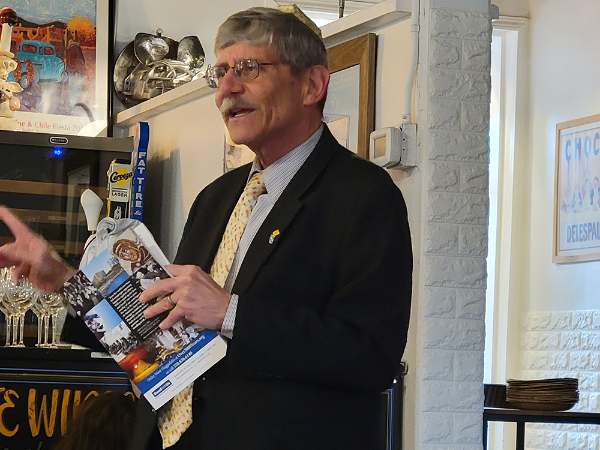
Los Alamos Community Seder at “Pig and Fig” Restaurant in White Rock, New Mexico. Photo courtesy Carol A Clark/ladailypost.com
Dear Friends:
As I write this quarterly message, I’m recuperating from leading successive community Seders in Santa Fe for HaMakom and Los Alamos for the Los Alamos Jewish Center. It strikes me that the Exodus story I’d have loved to have told would have had Moses commanding the people that as soon as they finished preparing the red chile breakfast burritos, everyone had to move out of Egypt posthaste and head to the wilderness. (Can you tell that I don’t like eating matzah?)
Nonetheless, I love the holiday of Passover. It brings back memories of Seders from when I was a child, and I’m reminded that I was referred to in our family as the wise son. No, that’s not quite right – I was the wise guy! I can even remember having a non-Jewish friend dress up as Elijah and stand at the door to surprise whoever opened it before we sang Eliyahu HaNavi.
On the second day of Pesach, I Zoomed in to East Midwood Jewish Center in Brooklyn where Beverly used to worship and which I’ve attended on occasion. (Surely Zoom services are a thin silver lining in the otherwise dark cloud of the COVID pandemic). EMJC’s Rabbi/Cantor Sam Levine not only has a beautiful voice but is a wise and inspirational leader. He spoke about Elijah and his multiple roles in Jewish texts, viz., announcing the coming of the Messiah or Messianic Era, resolving Talmudic disputes, and reconciling children to parents and parents to children.
The association of Elijah with the Messianic Age derives from II Kings 2:1-11 in which a chariot and horses of fire appears, and Elijah is described as ascending to Heaven in a whirlwind. Since he did not “die,” Elijah is thought to wander the earth, often disguised as a poor man. In the Haftarah I chanted on Shabbat HaGadol only hours before the first Seder this year, we heard from the prophet Malachi 3:23 that Elijah would be sent by G_d “before the coming of the great and awesome day of the Lord.” We sing about Elijah when that door is opened because we yearn for the redemption which he will herald, and we also sing that song at the conclusion of Shabbat because we pray that the announcement will come in the new week which is starting.
Elijah’s role in settling arguments about Jewish law is dependent on a backronym, an acronym deliberately formed from a phrase whose initial letters spell out a particular word or words. In the Talmud, the word teyku concludes an open-ended argument and means, literally, “let it stand,” or “we’re stuck.” But creatively, one can read teyku as shorthand for Tishbi y’taretz kush’yot U-ve’ayot – “Elijah the Tishbite will resolve all problems and difficulties.”
Lastly, the final verse of the Book of Malachi 3:24 states that when Elijah comes, “he shall reconcile parents with children and children with their parents.” Apparently, parental estrangement was an issue even thousands of years ago, but the contemporary psychologist and author, Dr. Joshua Coleman, argues that our emphasis on individualism in today’s society has driven epidemic levels of adult children cutting off contact with parents. On a deeply personal level, I pray that Elijah comes soon. Ken yehi ratzon – so may it be G-d’s will.
B’shalom,
Rabbi Jack
Rabbi Jack Shlachter
Judaism for Your Nuclear Family
physicsrabbi@gmail.com
Below is my reading list from the past quarter, with an asterisk denoting a particularly enjoyable selection. Don’t be deceived – there are several short poetry collections embedded therein.
The Last Kings of Shanghai* – Jonathan Kaufman
Love – Maayan Eitan
Next Generation Judaism – Mike Uram
Marrano Mountain* – Amnon Shamosh; tr. Suzy Shabetai
Hasidic Wisdom: Sayings from the Jewish Sages – Simcha Raz; tr. Dov Perez Elkins and Jonathan Elkins
Determined: A Science of Life Without Free Will – Robert Sapolsky
Meant to Be – Shira Gorshman; tr. Faith Jones
Megaovertone: Selected Poems 1952-1966 – David Avidan; tr. the poet and Abraham Birman
From Island to Island – Harold Schimmel; tr. Peter Cole
Yma, Ava; Yma, Abba; Yma, Oona; Yma, Ida; Yma, Aga…and Others – Thomas Meehan
The Books of Jacob – Olga Tokarczuk; tr. Jennifer Croft
The Bibliomaniacs* – J.C. Halper
Sepher Ha-Razim: The Book of Mysteries – tr. Michael Morgan
Poems by Zalman Shazar – tr. Joseph Leftwich
Beaufort* – Ron Leshem; tr. Evan Fallenberg
Life in a Mirror – Israel Emiot; tr. Francesca Guli’ et.al.
Day – Amir Or; tr. Amir Or and Fiona Sampson
The Last Laugh – S.J. Perelman
Hayim Nahman Bialik: Poet of Hebrew* – Avner Holtzman; tr. Orr Scharf(The epilogue served as our siyyum text for overriding the fast of the firstborn before Passover this year)
Chaim Nachman Bialik: Selected Poems – tr. Ruth Nevo
The Dick – Bruce Jay Friedman