Don’t Worry – Be Happy – It’s Adar‏

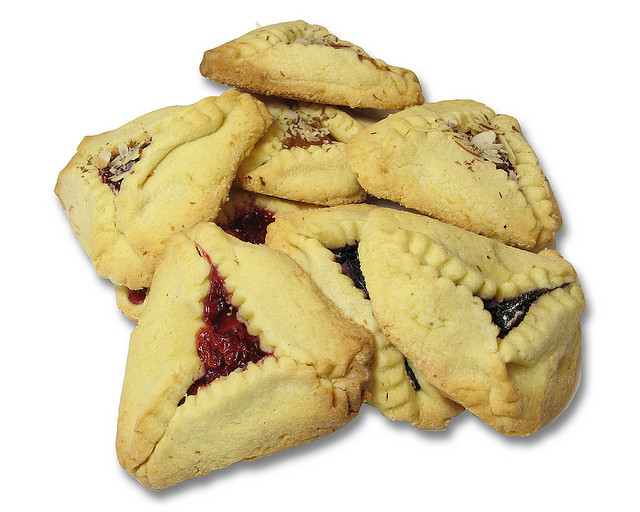
hamantash

The ancient midrashic work, Vayikrah Rabbah (IV:6), contains the following anecdote. Rabbi Shimon bar Yohai, a Palestinian rabbi of the second century of the Common Era, taught: “[There once was] the case of men on a ship, one of whom took a hand drill and began boring a hole beneath his own seat. His fellow travellers said to him: ‘What are you doing?’ Said he to them: ‘What does that matter to you, am I not boring under my own place?’ Said they: ‘But the water will come up and flood the ship for us all.’”

As I compose this next installment in my series of rabbinic quarterly messages, I am reflecting on a session at the recent adult Jewish education event in Albuquerque called A Taste of Honey, sponsored by the Jewish Community Center. The panel discussion I attended was called “Pew and Jew,” and it included a summary of the findings from the Pew Research Center survey of Jews in America as well as touching on the implications and applicability of the results on the Jewish communities of New Mexico. Whether you agree with the findings of the survey or not, for me one inescapable truth is that we Jews are all on the same ship, and when one Jew begins drilling a hole in the bottom of the boat, we all are in danger. The Babylonian Talmud Shevuot 39a says succinctly that all Jews are responsible for one another.

During an earlier session at A Taste of Honey, I taught a class about Jewish culinary traditions from Biblical times through the medieval era entitled “The People of the (Cook) Book.” Among my other rabbinic activities over the past three months was the opportunity to deliver the opening prayer one day during the New Mexico State Senate session. I shared with the legislators the same anecdote above to inspire them to work together on behalf of the citizens of New Mexico.

Beverly and I took a mini-vacation at the end of December and traveled to the southern part of New Mexico. At Temple Beth-El in Las Cruces, I presented a D’var Torah on Shabbat courtesy of Rabbi Larry Karol, and the following day, I conducted a wedding ceremony on a majestic spot of undeveloped land just outside the Gila Wilderness. Both bride and groom, along with most of the relatives present, were Ph.D. scientists, and somehow it seemed fitting to have the officiant be a Ph.D. physicist rabbi.

Rabbi Malka Drucker, founding rabbi of the HaMakom congregation in Santa Fe, has been away on a multi-month leave, giving me the privilege of leading services on a regular basis with Hazzan Cindy Freedman. Many of the congregants, including me and Beverly, travelled up to Boulder, Colorado at the end of January to celebrate as Cindy received her ordination as a full-fledged cantor. It was a tremendously moving ceremony, and we were all proud of Hazzan Cindy’s accomplishment. Beverly and I stayed on in Boulder for the next three days attending the annual conference of OHALAH, the Association of Rabbis for Jewish Renewal. It was a wonderful experience, and I hope to attend this conference in future years.

Looking over my reading list of the past three months, it appears that I’ve focused disproportionately on the scholarly, possibly a reflection of some increased responsibilities at Los Alamos National Laboratory which have forced me to make multiple trips to Washington, D.C. in search of funding. Those long flights are conducive to massive tomes. I enjoyed Essential Papers on Judaism and Christianity in Conflict: From Late Antiquity to the Reformation – edited by Jeremy Cohen, Genius: Elijah of Vilna and the Making of Modern Judaism by Eliyahu Stern, and Studies in Jewish Law, Custom and Folklore by Jacob Z. Lauterbach. For lighter reading, I recommend Jewish Anecdotes from Prague by Vladimir Karbusicky and Super Sad True Love Story by Gary Steyngart. And for a different slice of Judaism than traditional Ashkenazic fare, I found Baghdad, Yesterday by Sasson Somekh a most pleasurable escape.

When next I write to you, we will have emerged from slavery and celebrated our freedom during Passover. I urge you to look out for your fellow Jews, making sure that everyone has a seder to attend.

And if you see them lift a hand-drill or start to deliver a long sermon, be careful they don’t start boring.

B’shalom, Rabbi Jack
Posted in Rabbi Jack's Quarterly

Light (at least) One Candle

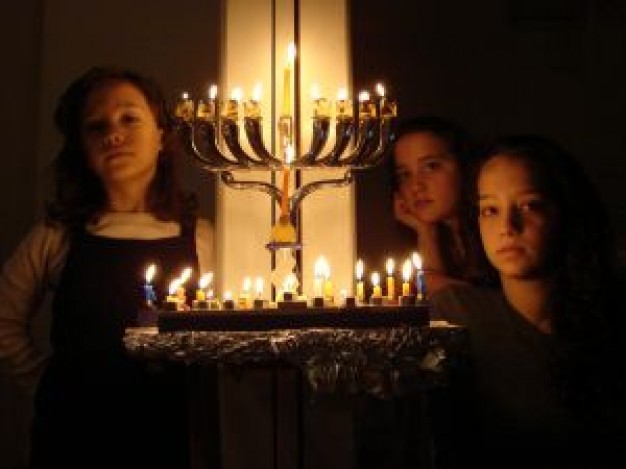
kids-behind-chanukah-menorah-

This rabbinic quarterly update looks back to August, September and October which were rewarding and enjoyable, contrary to a teaching in the Babylonian Talmud Tractate Yoma 29a that “the end of the summer is worse than the beginning of summer.” According to Rashi, the Talmud is referring to the heat and its injurious effects, but I find the High Holidays with their accompanying preparation time and subsequent quietude most fulfilling. 

High Holidays: Chavurat HaMidbar in Albuquerque graciously invited Beverly and me to participate in their annual retreat, this August held in Taos, and I used the opportunity to speak about repentance and its evolution from Biblical texts to contemporary writings.

Shofar-cartoonRosh Hashanah itself found us in Cheyenne, Wyoming, where I served as shaliach tsibbur in the beautiful sanctuary of the Mt. Sinai synagogue. It was wonderful to reacquaint ourselves with people we’d met two years ago when we visited the shul before seeing former Los Alamos congregant Jay Wechsler, zikhrono livrakha, and we made several new friends as well.

For Yom Kippur, it was back to New Mexico, where I led services in the building built by Temple Montefiore, the oldest congregation in the state. Though the community decreased in size from its peak in the early part of the twentieth century and eventually was forced to sell the building, the current Jews of Las Vegas have been working hard to reconstitute their presence. Beverly and I were honored to be the guests of the congregation from Friday through Sunday, and we appreciated the generosity of the Los Alamos Jewish Center which loaned a Torah scroll for the holiday. During the afternoon break on Yom Kippur I held an open question and answer session with topics ranging from Kabbalah to Jewish philosophers to raising a Jewish child.

RoundChallah

On Erev Sukkot Beverly and I shared a lovely meal with dear friends under the bamboo s’chach of our sukkah and then went to sleep in sleeping bags later that evening. Some time after midnight I was awakened by gentle drops of rain on my face, and shortly after dragging our gear into the house, the heavens opened up. While we didn’t try to sleep out there again, Beverly and I had all our meals in the sukkah and enjoyed being back home for this most joyous of holidays. I led Shemini Atzeret services in Los Alamos, and then we headed to HaMakom in Santa Fe for Simchat Torah. The culmination of that service was the now-traditional unfurling of the entire scroll with congregants standing in a circle holding the text. Rabbi Malka and I were inside the circle offering prognostications inspired by the Torah text held by each individual. Time will tell how prescient I was.

Life Cycle Events: In other rabbinic duties over the quarter, I had the opportunity to assist with virtually every Jewish life-cycle event, from birth to death. My mother’s only sibling, my Uncle Charles, passed away in Florida before the High Holidays, and it was indeed sad to serve as rabbi for his funeral service, despite the pleasure of seeing my cousins, brother and mother. More joyous was the year-long conversion process for three adults which culminated in their “birth” as Jews, and I felt like a proud parent when I called these three, along with two other members of HaMakom, to the Torah as B’nai Mitzvah last month. Perhaps my favorite ceremony is a wedding, and recently I officiated at a lovely event north of Santa Fe on a glorious fall afternoon.

Books: As usual, my free time has been spent immersed in books from our ever-growing library. The library was a great asset in preparing me for a presentation at the annual New Mexico Jewish Historical Society meeting. This year’s theme was the Sephardic heritage, both in New Mexico and in Spain. My talk had the lengthy title of “Islam and Christianity Clash with Judaism in the Sephardic World: Maimonides’ Letter on Apostasy and Nachmanides’ Disputation at Barcelona.” In addition to delivering this lecture, I also got to lead Havdalah before the Saturday evening session.Two growing areas in our library are Israeli fiction and Yiddish fiction in English translation; in the former category I particularly enjoyed reading The Story of Aunt Shlomzion the Great by recently deceased Yoram Kaniuk while in the latter I was entranced by From Man to Man by Moshe Nadir. In the scholarly realm, I heartily recommend Burnt Books by Rodger Kamenetz whose visit to Santa Fe inspired my choice of reading material.

Assuming my progress in the 7 ½ year cycle of reading the entire Babylonian Talmud stays on track, I should shortly read the aforementioned passage from Tractate Yoma, and I may learn more about the difficulties associated with the end of summer. In the meantime, I wish you a joyous Chanukah and winter.

B’shalom, Rabbi Jack

Posted in Rabbi Jack's Quarterly

L’shana Tova 5774

Shofar on tallitThe best I can do at encapsulating the Jewish concept of repentance is “I’m sorry and feel badly for what I did wrong, and I’m trying hard not to do it again.” As I compose this quarterly rabbinic message, we are rapidly approaching the High Holidays, and I am focused on repentance. With each passing year, I delve deeper into the meaning and beauty of the extended Jewish calendar season that starts around mid-summer and extends through Sukkot in the fall. I’ve been reading the powerful book by Rabbi Alan Lew entitled, “This is Real and You Are Completely Unprepared: The Days of Awe as a Journey of Transformation,” and will use this theme for several upcoming talks and sermons.

Over the last three months I was privileged to officiate at several life cycle events. A teenage friend, navigating difficult family relationship issues, sought solace in a name-change ceremony. For my remarks, I referenced the text from Tractate Rosh HaShanah. In the Talmud, change of name is mentioned along with repentance, prayer, and charity in the list of actions to avert the severe decree. A more joyous leadership opportunity was my inaugural same-gender marriage ceremony. I felt honored to join two people together whose love and commitment toward each other was so evident; this first-time (but hopefully not last) ceremony afforded me the chance to recite the Shehechiyanu.

I had most fulfilling worship experiences leading services in Los Alamos, Santa Fe, and Las Vegas, New Mexico over the past quarter. My Shabbaton in Las Vegas was held in the acoustically exquisite and historic former Montefiore Synagogue. Following Saturday services I spoke about the role of books in the Jewish text tradition. In Santa Fe, several die-hards listened to my 1 AM lecture on Rabbinic roots of conversion during late night Shavuot study. Other teaching moments were both formal (my monthly classes with the adult B’nai Mitzvah students of HaMakom) and informal (at the end of the service on my Dad’s Yahrzeit where I was joined by Dov and my Mom). graduation_guy_3

My daughter, Orli, graduated high school in June, and I shared a Hasidic teaching at the service honoring the graduates. At a reconciliation ceremony on Hiroshima Day marking the opening of a special peace art exhibit I offered a blessing for peace as well as words and song from Jewish tradition. And on a 10-day visit to Vienna in June I enjoyed sharing a few comments on the parasha after our Saturday lunches at Or Chadasch and taught a new tune to the congregation. Teaching goes hand in hand with learning, and I mastered the traditional trope for the Book of Lamentations this year just in time for Tisha B’Av. Over thirty years ago I began serious adult Jewish study with Rabbi Leonard Helman, whose recent death was such a loss to Jews and non-Jews alike in Northern New Mexico. May his memory serve as a blessing.

Beverly, my ezer k’negdo (“sustainer beside me”) spent five weeks in Brooklyn dealing with family issues, leaving me with a feeling of emptiness but also much free time for reading and purchasing books. On the scholarly side, I read Jewish Questions: Responsa on Sephardic Life in the Early Modern Period by Goldish and The Light of the Eyes by de’ Rossi. Lighter non-fiction included a biography titled Moses Mendelssohn: Sage of Modernity by Feiner and The Gods are Broken: The Hidden Legacy of Abraham by Salkin. I can heartily recommend the recent English translation of a Yiddish classic, The Zelmenyaners by Kulbak and two of Wiesel’s more recent works, A Mad Desire to Dance and The Sonderberg Case. Squeezing their way onto the shelves were several biblical commentaries by the 16th century Rabbi Moshe Alshich, plus These are the Words: A Vocabulary of Jewish Spiritual Life by Green, and My Father’s Paradise: A Son’s Search for his Jewish Past in Kurdish Iraq by Sabar among (probably too many) others. I am blessed that Beverly is so supportive of the library, lest I be forced to say “I’m sorry and feel badly for what I bought, and I’m trying hard not to do it again.”

Have a wonderful High Holiday season, and may you and all your loved ones be written into the Book of Life for a healthy and happy new year.

B’shalom, Rabbi Jack

Posted in Rabbi Jack's Quarterly

Counting up to Sinai

Rabbi Jack uses Moses and Miriam sock puppets to talk about Lashon Hara

Rabbi Jack uses Aaron and Miriam sock puppets to talk about Lashon Hara

Counting is a fundamental human activity – many of us count the number of e-mails in our in-boxes (this message describing my recent rabbi-ing activities is planned as one of only four per year), and starting on the second night of Passover, Jews around the world start another form of counting, namely a countdown to the holiday of Shavuot, celebrating our receiving the Torah at Mount Sinai. Over the past three months, I’ve had several opportunities to share Torah with friends; there is nothing I enjoy quite so much as experiencing the beauty of the weekly Torah portion with Jewish adults.

On a recent visit to the Washington, D.C. area for a family simcha, I was honored to lead a Torah discussion at Adat Shalom in Bethesda, transmitting teachings from Rashi through Hirsch to a wonderful and sophisticated group. In February my longstanding relationship with Chavurat HaMidbar in Albuquerque resulted in a most enjoyable Shabbat afternoon session on the medieval commentators, and after Havdalah, I delivered a variant of my talk on Jews in Theoretical Division at Los Alamos during World War II.

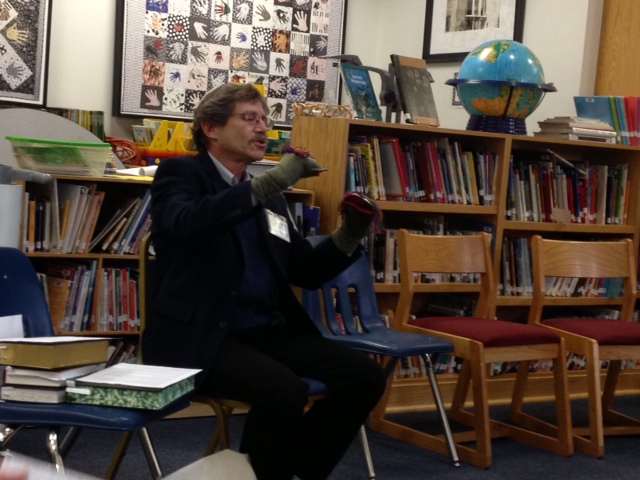
The next day I was one of the speakers at the annual Albuquerque adult Jewish education event called A Taste of Honey. My topic was Lashon Hara (gossip), and my sock puppet friends from last Yom Kippur made their New Mexico debut (see photo). I’ve delivered several other Jewish-themed presentations of late (alas, all the rest without sock puppets), including a talk entitled “Jewish Prayer and the Jewish Pray-er” as part of the annual Lenten series in Los Alamos, a Pre-Passover Workshop in Las Vegas, New Mexico, and “With Stars in Their Eyes: Astrology in Jewish Texts” as part of HaMakom of Santa Fe’s continuing adult education series. The Northern New Mexico Chevra Kaddisha, devoted to preparation of bodies for traditional Jewish burial, offered an afternoon training last month where I provided insights into “The Liturgy of Tahara and Etiquette in a House of Mourning.”

The powerful passage in Psalms (90:12) asking G_d to “Teach us to count our days rightly, that we may obtain a wise heart” reminds us that life is not without end. No sooner did I complete my discourse to the Chevra Kaddisha than I learned of the death of a dear family friend, and shortly thereafter I was on a plane to California to conduct the funeral service for this woman whom my mother befriended in high school. May her memory serve as a blessing.

These past three months I’ve conducted Shabbat services in Los Alamos and Santa Fe, led a community seder, paid healing visits to people both familiar and completely unknown, spoken with potential converts, educated an adult B’nai Mitzvah class on the topics of Passover, the Holocaust, and Israel Independence Day, and last but far from least, presented the daily prayer beginning the State Senate session. I doubt the hallowed chambers of the Merry Roundhouse in Santa Fe have rung before with words about the House of Hillel and the House of Shammai (whom I described as early Democrats and Republicans).

I try hard not to count the number of books that are in our library, but Beverly and I watched somewhat in disbelief as an entire bookcase, empty only last month, filled up over the course of a week. A few of the recent acquisitions include Jewish Bible commentaries (Malbim on Ruth, Kimhi on Psalms, Kli Yakar on Deuteronomy), Yiddish fiction (At the Edge of Dreamland by Eisenman, Temptations by Pinsky), contemporary Hebrew writing (A Different Source by Izakson, World Cup Wishes by Nevo), theology (I’m G_d; You’re Not by Lawrence Kushner, The Book of Job by Harold Kushner), and the five volumes now available in the new Koren Talmud series. A trip to Vienna in March helped me attack some relatively massive tomes on the shelves (Hasidism Reappraised by Rapoport-Albert, East River by Asch) but I also consumed some slimmer volumes (Conversations: Primo Levi & Tullio Regge, Book of My Mother by Cohen). Two inexpensive and consistently high quality series which I recommend are Jewish Encounters (Schocken) and Jewish Lives (Yale University Press); I just read Benjamin Disraeli by Kirsch in the former and purchased Moshe Dayan by Bar-On in the latter.

There are still dozens more books to order, but who’s counting?

B’shalom, Rabbi Jack


Posted in Rabbi Jack's Quarterly

Did the matzah see its shadow?‏

While last Shabbat could have been called “Groundhog Shabbat,” this coming weekend marks the first of a series of “named” Sabbaths to help us prepare for the holiday of Passover. Shabbat Shekalim is followed in short order by Shabbats Zachor, Parah, and HaChodesh, and two weeks later we observe Shabbat HaGadol immediately preceding the first seder. As with the High Holidays when an advance period of self-evaluation is conducted, the rabbis encourage us to use this period of named Sabbaths to search and destroy the things in our lives which have fermented or turned sour. These can include bad habits and negative attitudes, for example, and this process of making a fresh start is part of the meaning behind Passover.

As I look back on the past three months, I feel especially blessed by the wide variety of rabbinic opportunities I’ve had. At HaMakom in Santa Fe, I’ve had the great pleasure to serve on the “left” side of the bench (as Chazzan with Rabbi Malka), on the “right” side of the bench (as Rabbi with Chazzan Cindy), and even in the “middle” of the bench when both members of the A-Team were away, while at the Los Alamos Jewish Center I’ve led services on the front and back sides of Shabbat (Friday night and Havdalah respectively).

Bringing other dimensions into the equation, I’ve also been truly privileged to perform life cycle events ranging from the joyous (conducting a wedding ceremony on the 21st floor of a downtown San Francisco hotel for an expat Los Alamosan whom I’ve known for decades) to the mournful (escorting the remains of a Los Alamos Jewish Center founding member to his final resting place). One of my favorite teens became an Eagle Scout last month, and I was deeply honored to deliver the invocation at his induction ceremony, even managing to sneak a little Torah teaching into my remarks before anyone knew what was happening.

My favorite rabbi-ing, however, is still teaching, and this past quarter was filled with teaching moments. The talk I put together over a year ago on Jews in Theoretical Division at Los Alamos during the Manhattan Project got ample exposure with presentations to a Pittsburgh-based Jewish singles tour group, Santa Fe Hadassah, a Road Scholars (formerly Elderhostel) group, and the Los Alamos Historical Society, this last version captured on DVD for posterity. I also completed a year-long weekly discussion series at HaMakom on the Torah portion of the week as viewed through the eyes of five different medieval commentators.

For now, I am taking advantage of the extra hour of sleep, but I suspect that the pull of a willing group of students will eventually lure me back to a text-based program before Saturday Shabbat services. The Los Alamos High School Humanities classes invited me back again this year as part of their comparative religion unit, and I spent a good fraction of a day in December teaching Talmud (well, sharing a few passages) to seniors. Beverly and I were encouraged by a dear friend from New York to head for a warmer climate with her over Thanksgiving, and while enjoying unseasonably warm temperatures in Tucson, I was welcomed as Scholar in Residence at Bet Shalom, offering a D’var Torah and an after lunch talk entitled “Stuffing Ourselves with Torah: A Thanksgiving Postlude.”

There’s always time for learning as well – it gives me a feeling of satisfaction to stay on track with a page of Talmud a day in the world-wide Daf Yomi program, but I’ll be happy (I think) when we finally finish Tractate Shabbat. My other reading this quarter has again spanned the spectrum from the “quite” scholarly (Abortion in Judaism by Daniel Schiff, The Student’s Guide Through the Talmud by Zevi Hirsch Chajes) through the “moderately” scholarly (Jewish Mysticism by Rachel Elior, A Book Forged in Hell by Steven Nadler) to the “popular” (Kosher Sutra by Shmuley Boteach) with some Israeli fiction in English translation (Heatwave and Crazy Birds by Gabriela Avigur-Rotem and Scenes from Village Life by Amos Oz) thrown in for good measure. Sadly, my book-buying has trickled to nearly zero this quarter, but I did purchase a copy of Arise!Arise! Deborah, Ruth and Hannah with illuminations and commentary by former Santa Fean and gifted artist Debra Band. Anticipate a HUGE list of recent purchases in my next quarterly missive when I make up for this dry spell, and have a Hag Kasher V’Sameach at the end of March.

B’shalom, Rabbi Jack

Posted in Rabbi Jack's Quarterly

In Elul a young man’s fancy lightly turns to thoughts of love‏

Cake

As I compose this quarterly message about my rabbi-ing adventures, we’ve left the month of Elul far behind. The rabbis have traditionally encouraged self-examination and reflection starting on Rosh Hodesh Elul. I intensified my focus on High Holidays by leading religious services at the onset of Elul, first on Friday night in Los Alamos and then on Saturday morning at HaMakom in Santa Fe. The following day, I shifted (brass) gears and conducted the steampunk-themed wedding ceremony for a lovely young couple in Los Alamos. Elul can be expanded as an acronym for “Ani L’dodi V’dodi Li” – “I am my beloved’s and my beloved is mine,” and the month is propitious for marriage.

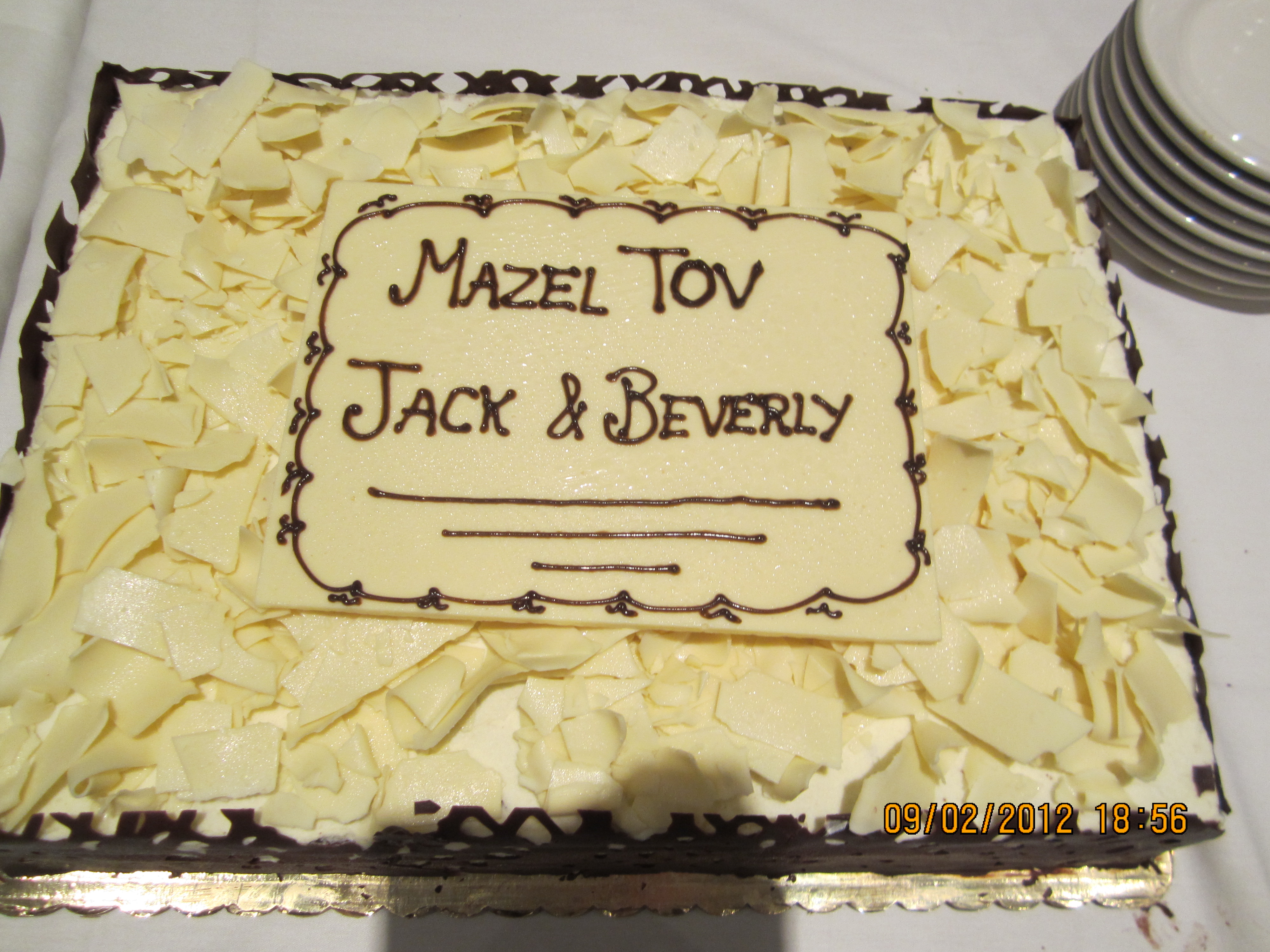
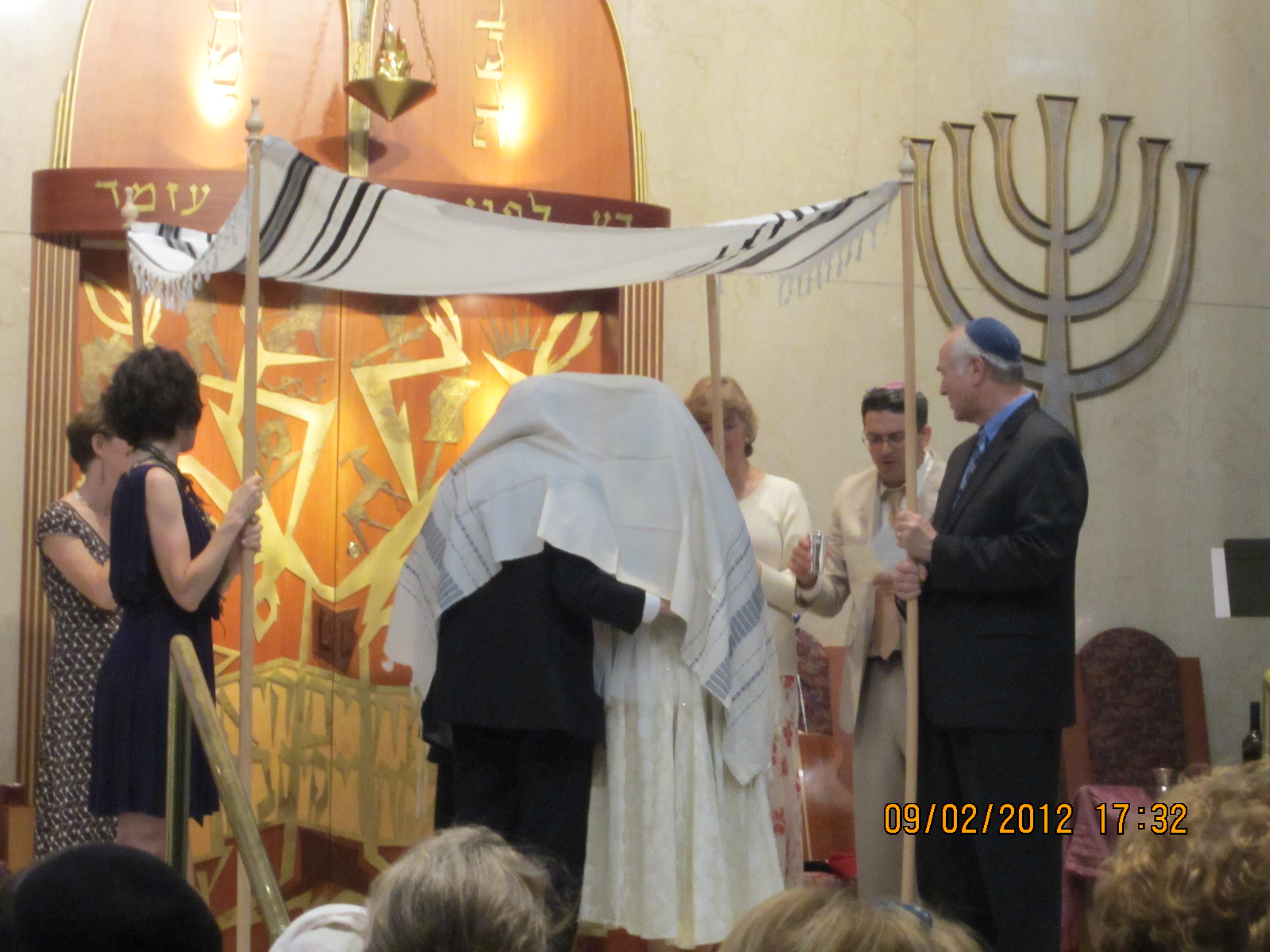
Two weeks later, at the midpoint of Elul, Beverly and I were married in Brooklyn, New York, at a ceremony which lacked even a hint of steampunk but was unquestionably the most moving experience of my life. Having my two children, brothers, sister-in-law, niece, and mother safely arrive in time for the event was yet another demonstration that miracles still happen, and sharing in the love of all present including two of my dear friends from college and two of Beverly’s dear friends who held the four chuppah poles was literally heavenly.

Chuppah tallit

We didn’t get to rest too long – Beverly and I headed off to Vienna, Austria, eight days later for the first of what I hope are several itinerant rabbi opportunities. Or Chadasch, the only progressive synagogue in Austria and my second home during my year in Vienna in 2008, invited me to lead High Holiday services this year. My preparation with both German/Hebrew and English/Hebrew machzors in front of me (couldn’t they have made the pagination the same?) led to a most rabbinically-satisfying enterprise from the beginning of Rosh Hashana to the end of Yom Kippur despite lingering hints of jetlag.

Credit goes to the wonderful members of Or Chadasch who willingly tried out all my spiritual experiments, tolerated my attempts at German, and listened and participated during my English sermons. Our worship together during the Yamim Noraim (Days of Awe) was an experience I will never forget and for which I am most grateful.

Back in New Mexico, my year-long Parashat Hashavua class is in its home-stretch, and we recently began the book of Genesis using Rabbi Ovadiah Sforno, a 16th century Italian exegete, as our commentator-of-the-book. These hour-long weekly discussions have been intellectually stimulating for me, and I’ve enjoyed getting to know Rashi, Rambam, Ibn Ezra, and Rashbam along the way. Their books have been sitting on my shelf unused for far too long, so it’s great to dust them off and put them to work.

New tomes have taken up residence on our bookshelves, but with all the traveling, there have been only a few recent acquisitions. With a gift from the Los Alamos Jewish Center, I now have what I suspect is the only copy within 500 miles of The Logic of Gersonides, a philosophical work by one of the major 14th century Jewish intellects, and my standing order of the Yerushalmi, the “other” Talmud, resulted in a few new volumes, namely the tractates Rosh Hashana and Sanhedrin.

Daf Yomi – a 7 ½ year commitment

As for reading, it’s been hard to find the time, in part because I have embarked on a 7 ½ year journey to read a page of the Babylonian Talmud daily, with hopes that I, along with probably a few hundred thousand others, will celebrate completion of the entire work in January, 2020. I’ll share more about Daf Yomi in my next missive, assuming I stay on track. In the meantime, I do recommend the following books which I consumed mostly on plane flights and while sitting in the sukkah: The Other Talmud: The Yerushalmi by Rabbi Judith Abrams (highly readable and informative), The Hare with Amber Eyes by Edmund De Waal (a fascinating Jewish family saga), Three Cities by Sholem Asch (translated from the Yiddish and great for transatlantic travel), and Sarah: The Life of Sarah Bernhardt by Robert Gottlieb (the story of an amazing and amazingly modern persona).

B’shalom, Rabbi Jack


Posted in Rabbi Jack's Quarterly

A Day of Mourning – a Path Toward Happiness

Dear Friends:

Today marks the saddest day on the traditional Jewish calendar, the observance of Tisha B’Av.  This 25-hour fast is as difficult to observe as Yom Kippur (maybe even more difficult because it occurs when temperatures are higher and days are longer) and commemorates the destruction of both the First and Second Temples in Jerusalem.  Yet even in our bleakest moments the seeds of hope are planted.  The Talmud of the Land of Israel teaches us that the birth of the Messiah is linked to this day (new Artscroll edition Berachos p. 25 b2), the message, I believe, being that we should always try to keep faith in a bright future even when we don’t feel particularly optimistic.

As I look ahead at the next few months, I am astounded at how blessed I am.  Over Labor Day weekend, Beverly and I will be married in Brooklyn, New York, sharing in the joy of this New Mexico → New York “destination wedding” surrounded by our families and a few local friends.  I constantly marvel at the miracle of our meeting almost three years ago at a Shabbat morning HaMakom service in Santa Fe, and I look forward to an ever deepening relationship with this amazing woman.

No sooner do we get back to New Mexico (and wash a few clothes) then we pack up and head out to Vienna where I’ll be leading High Holiday services with Chazzan Mitchell Ash and my dear friend, composer and keyboardist Jakob Sint.  These past several weeks have been focused on preparations for the Days of Awe – the Yamim Noraim – and I  am greatly excited (and have some trepidation because of my lack of familiarity with the Mahzor used in Vienna) to be spending two weeks with the wonderful members of Or Chadasch.

Beverly and I will then return in time, barely, to erect our sukkah and enjoy some relaxation during Sukkot in Los Alamos. Meanwhile Dov will have returned to University of Washington where I am proud to say he is now officially a student in the Computer Engineering Department. Orli will be busy as usual; she’s entering her senior year at Los Alamos High School, juggling rugby, hockey, lacrosse, bicycling and a score of Advanced Placement classes.

Outside of struggling with a German-Hebrew Mahzor, rabbinically I’ve managed to introduce two more commentators into my weekly Torah class at HaMakom, namely Abraham Ibn Ezra and Rashbam, and we’ve worked our way through the Book of Numbers with the former and started Deuteronomy with the latter.

At the Los Alamos Jewish Center, I had the privilege of leading the service honoring our High School graduates, and I reflected on how quickly time flies – it seems like only yesterday that we were honoring Melissa (now Rabbi Melissa) Klein as she headed off to college. Rabbi Klein was a star student in all my years of teaching the Post Bar & Bat Mitzvah classes, and I am delighted that she’ll be leading services over the High Holidays in Los Alamos while I’m in Vienna. Squeezed in during off hours, I’ve done some teaching for a conversion class and for a High Holiday trope class, and I’ve still found time to escape into some books.

The bookshelves are, as ever, bursting, and subsequent to my last rabbinic message, I’ve acquired Passover-motivated haggadot including “The Holistic Haggadah” by Michael Kagan, the “Israel Passover Haggadah” by Rabbi Menachem M. Kasher, and the recently published “New American Haggadah” edited by Jonathan Safran Foer with a new translation by Nathan Englander. I’ll try to peruse these additions to my library to find appropriate selections for inclusion in next year’s seders.

As for actual reading, after years of near-vegetarianism, last month I thoroughly enjoyed one of Beverly’s recommendations, “Vegetarianism and the Jewish Tradition” by Louis Berman. A few months ago we attended a rock musical in Santa Fe about the turn-of-the 20th century Jewish anarchist, Emma Goldman, and this inspired me to read “Emma Goldman: Revolution as a Way of Life” by Vivian Gornick, part of the excellent Yale University Press Jewish Lives series. Finally, also worth your consideration is Esther Kreitman’s novel “Diamonds,” published in Yiddish in 1944 and now available in an English translation by Heather Valencia. Three guesses why diamonds might be on my mind!

B’shalom, Rabbi Jack


Posted in Rabbi Jack's Quarterly

Countdown to Blintzes

Dear Friends:

We just passed the halfway point in the Omer, our annual countdown to Shavuot and the anniversary of receiving the Torah at Mt. Sinai, and I feel grateful as I count all the wonderful and diverse rabbinic opportunities I’ve had of late. In February I enjoyed leading the Tu B’shvat seder at the Los Alamos Jewish Center (LAJC) while eating an abundance of fruits appropriate for this New Year’s Celebration of the Trees.

Also Los Alamos-related, a young woman from our community who is now in college contacted me for some assistance on her National History Day project exploring Reform Judaism during its formative years in America, and I had a vicarious thrill when the project received high honors. And an independent film maker from Santa Fe dropped by my place one Friday to record my advice on his multi-year passion and laudable goal– a film about how halacha and Muslim religious tradition can be used to help address the conflict in the Middle East.

In the more conventional worship arena, I utilized some Saturday morning services in Los Alamos as teaching moments to examine the closing prayers, including Alenu, and to review the intricacies of

Passover. These discussions led to the Pesach holiday itself, and Beverly and I had the privilege of conducting the first seder with my Mom, brother Ted, and Beverly’s Dad in attendance with a dozen dear friends. I thought it particularly shrewd to “allow” my boss’s wife to find the Afikomen, thereby assuring myself of a healthy raise this year. We recuperated the next day and were ready once again to eat matzah at the Los Alamos Community seder where my role as leader included providing the text to the Four Questions in multiple languages, my favorite being “Valley Girl.”

Teaching, as always, has kept me busy. My friend, Zoe, who serves as Religious Director and teacher of the teenagers at the LAJC, parked me in the hot seat for nearly an hour while her students grilled me on topics ranging from G_d to nuclear weapons to why we don’t eat pork, with dozens of challenges in between. In my weekly early Shabbat morning Torah study at HaMakom in Santa Fe, we finished the weekly portions in Exodus where our focus was on the medieval commentator, Rashi, and have been immersed in an examination of Leviticus through the eyes of Ramban. Soon we’ll segue to Numbers, and I think we’ll become acquainted with Ibn Ezra; the intent is to gain a new perspective book by book for an entire year.

My annual presentation at A Taste of Honey, the Albuquerque-based Jewish adult education event held each February, provided a controversial approach to conversion in Judaism through an exploration of rabbinic texts. I also tried to generate some debate with my talk for the Los Alamos Lenten series entitled Birth Control: In the News and the Views of the Jews. By contrast, I felt like the blind leading the blind when I spoke recently at the Los Alamos Methodist Church on the Apocrypha using a translation of these extra-canonical books given to me nearly thirty years ago by my parents who sensed that my library wasn’t yet extensive enough.

I do manage to keep finding interesting items when I browse my shelves. Over the past few months I worked my way through a trilogy of studies on the Talmud, absorbing some modest fraction of the wisdom from “Charting the Sea of Talmud” by Yisrael Ury, “New Talmudic Readings” by Emmanuel Levinas, and “The Talmud as Law or Literature” by Irwin Haut. I also was totally engrossed in two books by Mitchell Chefitz, “The Seventh Telling” and “The Thirty-Third Hour,” both of which I recommend highly.

One of these days I hope to tackle “The Tree of Life” by Chava Rosenfarb for which I will need a big block of time. Thanks to the incredible generosity of my dear friends at Or Chadasch in Vienna, Austria, that block of time could well be the plane flight Beverly and I will take this September when I have a most amazing privilege of leading that congregation in High Holiday services. That Omer seems like it’s going by too quickly, and I’d best start thinking about appropriate High Holiday sermon material!

B’shalom, Rabbi Jack


Posted in Rabbi Jack's Quarterly

Are Groundhogs Kosher?

Dear Friends:

My last three rabbinic months have been busy but generally joyous, and I write this latest installment of roughly quarterly missives to you before the crunch of Purim and Passover. “Generally” but not exclusively joyous – the shortest day of the year brought with it the loss of Jay Wechsler, a truly unique source of daylight to the Jewish community of Los Alamos and to the entire town. I felt deeply fortunate to spend a few hours with Jay on Shabbat afternoon right after Thanksgiving, Beverly and I traveling straight up to Wyoming immediately after I co-led the LAJC-United Church Thanksgiving celebration with senior pastor Rev. David Elton. It was a wonderful visit, and Jay was in great form, regaling us with stories of the early days while surrounded by his children and grandchildren. I was greatly saddened and shocked to learn of Jay’s death, and I tried to pay back a small fraction of my debt to Jay by conducting the remembrance service attended by hundreds of his friends. Jay Wechsler had no equal, and may his memory serve as a blessing for us all.

Speaking of equals, in preparation for the trip I learned that Wyoming is called the Equality State because of the rights women have traditionally enjoyed there, and I chose to speak on the topic of Women and Equality in Jewish Tradition at the synagogue in Cheyenne after Friday evening services, thanks to the logistical arrangements provided by Rabbi Harley Karz-Wagman. This talk was perhaps less controversial than my description of Ghosts and Goblins in Rabbinic texts delivered after Halloween in the historic former synagogue in Las Vegas, New Mexico. Truth be told, I think those who attended were simply being patient while waiting for Beverly to teach some Israeli folkdancing.

My teaching was not restricted to adults this past quarter – I spent most of a day lecturing on Judaism to approximately 70 students in three different Humanities classes at the Los Alamos High School. It would not be an exaggeration to say that 70 people got their first taste of Talmud study while listening to the story of the prospective convert and Rabbis Shammai and Hillel. Our study at the Los Alamos Jewish Center in conjunction with my monthly Shabbat weekends in town has focused on the prayer book and Torah service mechanics, and we’ll be continuing this series this weekend with an exploration of the closing passages of the service. The series was beautifully interrupted when I officiated at the Bat Mitzvah ceremony for the charming and newest adult member of the Los Alamos Jewish community, Kayleen Lederman. At HaMakom in Santa Fe, I delivered my annual contribution to the monthly adult education lecture series with an examination of Jewish Ethical Wills, a largely hidden but beautiful literary genre. Also at HaMakom, we celebrated with food (and even hard liquor) upon completion of an extended set of weekly Talmud classes focused on a passage in tractate Baba Metzia. Our new classes started a few weeks ago and use the weekly portion as an introduction to the father of Torah commentary, Rashi.  My plan is to switch commentators with each book, shifting (I think) to Ramban for Leviticus. These classes are a real joy and motivate me to study parshat hashevua.

Not to worry, I still found time over the past few months to both purchase and read books. New additions to the bursting bookshelves include the six books in the Jewish Lives series published by Yale University Press (Sarah Bernhardt, Emma Goldman, Moses Mendelssohn, Solomon, Leon Trotsky, and Hank Greenberg so far), New Talmudic Readings by the French philosopher, Emmanuel Levinas, and The Modern Jewish Girl’s Guide to Guilt edited by Ruth Andrew Ellenson. I had an added dose of reading time as the secular calendar came to a close, and this gave me the opportunity to compare three separate Israeli autobiographies, Life on Sandpaper by Yoram Kaniuk, My Russian Grandmother and her American Vacuum Cleaner by Meir Shalev, and Curriculum Vitae by Yoel Hoffmann. Three more diverse memoirs would be hard to find, but I recommend all of them unabashedly. Despite the crowded shelves, I also welcome your suggestions for new books.   

B’shalom, Rabbi Jack

Posted in Rabbi Jack's Quarterly

Chesvan Comes to the Desert

Dear Friends:

Rabbis around the world love Cheshvan, the month we have just begun, because it has NO HOLIDAYS!!  This past month was quite busy, as expected, with High Holidays at the Los Alamos Jewish Center, the congregation to whom I am so grateful, followed by Sukkot followed by Shemini Atzeret/Simchat Torah (I attended five different synagogues in three days), and to top it off, Beverly and I decided to “end” the season by going to Roswell, New Mexico, for one of my semi-regular Shabbatons.

I enjoy greatly visiting with my Jewish friends from Roswell and Carlsbad, and I think we all had fun with the discussion topic for Shabbat afternoon of Ghosts and Goblins in Rabbinic texts. Nevertheless, I’m now looking forward to some rest and relaxation.  My current focus is on a planned Friday evening/Saturday morning Shabbat back at the Los Alamos Jewish Center on December 9-10 when I’ll be leading the congregation and providing a review on the mechanics of the Torah service – when do we rise, how do we recite the blessings for an aliyah, what is the etiquette surrounding the scroll, etc.

I began turning my thoughts to teshuva this year by teaching a class up in Taos, New Mexico, at the start of the month of Elul on the liturgy for this season – I’d forgotten how much I like offering educational programs at the Taos Jewish Center. My mother then joined us for Rosh HaShanah, and I dedicated my evening sermon to her, speaking on rabbinic parallels to the teachings of my parents during my youth (how does Pirke Avot address the concept of waiting an hour after eating before going swimming?).  The highlight of Yom Kippur for me, unquestionably, was listening to Orli chant Kol Nidre – the only comparable thrill in past years was hearing Dov blow shofar.  I thought Orli’s singing lifted the entire congregation to the level of the angels – one of the goals and images of Yom Kippur – but you’ll have to ask another congregant if you want an unbiased opinion of the beauty of that moment.

I concentrated my cantorial energies during the holidays, as usual, on evening services and Musaf, and as a result I had those tunes running through my head for weeks afterward.  The formal end to the holiday season, Simchat Torah, started off on a wonderful, spiritual level with a service led by my dear friend and colleague, Rabbi Malka Drucker, at HaMakom congregation in Santa Fe.  Rabbi Malka graciously allowed me to assist her as we unrolled the entire scroll in a circle of congregants and shared insights on individuals based on the parsha at his or her fingertips.

One of the great joys of being a rabbi has been conducting wedding ceremonies for former Bar and Bat Mitzvah students, and I was treated to this opportunity again in August when I served as the officiant in New York for one of my favorite “kids.” Perhaps I’ll receive phone calls from her two brothers when they decide to get married in the future!

My rabbi-ing duties often extend outside the synagogue – a notable recent example being a presentation at the annual conference of the New Mexico Jewish Historical Society on the Jews in Theoretical Division at Los Alamos during World War II.  I hope to reprise this talk in the future through the Los Alamos Historical Society – it was a lot of work preparing the talk but thoroughly entertaining to learn about some of the giants of physics.  

Of course I just had to buy a few books to gather the information I needed – one recent purchase was a copy of The History of the Los Alamos Jewish Center by Rabbi Abraham Shinedling (1958).  Keeping it company on my increasingly crowded bookshelves are a few other newcomers including A Torah Commentary for Our Times by Rabbi Harvey J. Fields (1995) and The Study of Judaism: Bibliographical Essays by Richard Bavier (1972).  Lest you think that all my purchases are highbrow, I also now have a copy of Old Jews Telling Jokes by Sam Hoffman (2010), and please don’t ask me about Dr. Drobkin (he’s on page 183).

As for reading in my spare time, I’ve gotten great pleasure of late from a relatively recent Israeli novel called Thera by Zeruya Shalev translated from Hebrew into English, a memoir entitled In Search of Memory by the Nobel chemistry prize winner and Viennese-born Eric Kandel, and the graphic novel The Cardboard Valise by one of my favorite artists, Ben Katchor.

I hope the month of Cheshvan brings you (and me) some welcome reading time, and may your prayers from these past High Holidays all be answered.

B’shalom, Rabbi Jack

Posted in Rabbi Jack's Quarterly