
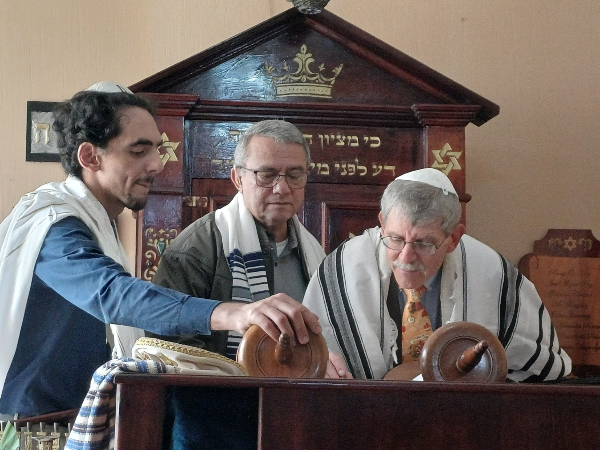
Adat Israel, Guatemala City
Dear Friends:
One of the luxuries of not making my living as a rabbi is that I don’t deliver very many sermons. (I suspect this is viewed as a great benefit by my congregants as well). In fact, I love to follow the tradition that rabbis only offer two sermons a year.
Historically, those sermons were given on the Sabbath preceding Passover – in order to remind attendees of the intricacies of food restrictions on that holiday – and on the Sabbath between Rosh HaShanah and Yom Kippur – to inspire us to continue our process of repentance as we approach the Day of Awe. For many years now, I have modified that custom and speak only on the eve of the New Year and the eve of the Day of Atonement.
This past Yom Kippur I delivered my second (and final!!) sermon of the year while leading congregation Adat Israel in Guatemala. For my remarks, I spoke about how important it is that we are careful with our speech, and I pointed out that a significant fraction of the items listed in the public confessional prayers on Yom Kippur relate to things we say, particularly about other people. So, without a doubt, we should be careful about what comes out of our mouths.
In this (post?) Covid world, many of us have become especially conscious about what comes out of our noses as well, and how we can hurt those around us by failing to catch our sneezes. If you’re like me, you may instinctively say “God bless you” when someone sneezes, but we often forget what we even mean by a blessing.
There is a wonderful Jewish tradition that we are to recite 100 blessings a day (B. Men. 43b and see the comprehensive article at https://outorah.org/p/36791/). Elsewhere in the Talmud (B. Ber. 60b) we are provided with text for a series of blessings to be recited upon awakening.
The practice of starting the day off by recognizing things for which we should be grateful not only made sense thousands of years ago but seems extremely relevant even today. There is no guarantee that we will wake up to a new day, and the rabbis likened sleep to death. Hence, when we realize that we are again conscious, we should express our thanks. Similarly, when we open our eyes, we are encouraged to acknowledge our gift of sight. The Talmud continues to say that when we dress ourselves, we should recite a blessing to God who clothes the naked (apparently, pajamas were invented after the Talmud was codified).
Subsequently, those passages were transferred to the synagogue where they became a sequence of fifteen morning blessings. There are two blessings in the collection of codified synagogue morning blessings for which I recently gained additional appreciation.
The first is the blessing that was associated with sitting up straight from one’s bed – one is to say, “Blessed are You who sets captives free (matir assurim).” Those words were extremely powerful and present as the Los Alamos Jewish Center, along with thousands and thousands of other Jewish communities around the world, came together publicly with great joy yet mixed with sadness when the last of the living hostages were released by Hamas. May we never again face such a situation, and may our recitation of that blessing remind us how fortunate we are to be free.
The second blessing that jumped out at me recently is more liturgically controversial. Some prayerbooks say “Blessed are You who has not made me a heathen,” or in the positive variant, we find “Blessed are You who has made me an Israelite (or Jew).” The text in the Talmud probably underwent censorship as evidenced by a difference between printed versions and manuscripts (see, eg., My People’s Prayer Book Volume 5 p.26 note 1).
It is not my intention to explore here the pros and cons of the positive/negative formulations but rather to express my thanks to Adat Israel for enhancing my awareness of the blessing of being Jewish. No other congregation has ever shared with me such enthusiasm when reciting these words. Bendito sea el Dios Eterno, quien me ha hecho judio (as the book we used in Guatemala stated!). And let us say, Amen.
B’shalom,
Rabbi Jack
Rabbi Jack Shlachter
Judaism for Your Nuclear Family
physicsrabbi@gmail.com
www.physicsrabbi.com
My reading list for the past quarter follows here with an asterisk denoting a work of particular interest to me.
What Makes an Apple? – Amos Oz with Shira Hadad; tr. Jessica Cohen
The Liar – Ayelet Gundar-Goshen; tr. Sondra Silverston
Class Clown: The Memoirs of a Professional Wiseass – Dave Barry
The Way Into Jewish Prayer – Lawrence Hoffman
Sex Ethics in the Writings of Moses Maimonides – Fred Rosner
Whitewash: Poland and the Jews – Jan Grabowski
The Old Story – Mendele Moykher Sforim; tr. Jane Peppler
The World of the High Holy Days Volume 3* – edited by Rabbi Jack Riemer
The Shoes of Tanboury – Shimon Ballas
Mishkan Halev: Prayers for S’lichot and the Month of Elul – ed. Rabbis Janet and Sheldon Marder
Origins of Life – Freeman Dyson
The Einstein Effect – Benyamim Cohen
A Cure for Sorrow – R. Shem Tov Ibn Falaquera; tr. Yitzhak Berdugo
Manasseh of Ilya: Precurser of Modernity Among the Jews of Eastern Europe – Yitzhak Barzilay
The Black Hole of Auschwitz – Primo Levi; ed. Marco Belpoliti; tr. Sharon Wood
A Letter in the Scroll – Jonathan Sacks
Drops of Joy – Moshe Shklar; tr. various
Yiddish Short Stories – ed. Isaac Goldbert; tr. various
The Sacred Count of Days – Vincent James Stanzione
Elephants by Night – Abraham Sutskever; tr. Mel Konner
Ada – Vladimir Nabokov